
Visible Light Initiated Thermoresponsive Aqueous Dispersion Polymerization-Induced Self-Assembly
Yajie Ma, Pan Gao, Yi Ding, Leilei Huang, Lei Wang, Xinhua Lu, and Yuanli Cai*(蔡远利)
State-Local Joint Engineering Laboratory of Novel Functional Polymeric Materials, Suzhou Key Laboratory of Macromolecular Design and Precision Synthesis, Department of Polymer Science and Engineering, College of Chemistry, Chemical Engineering and Materials Science, Soochow University, Suzhou 215123, China
Macromolecules2019, 52, 1033--1041
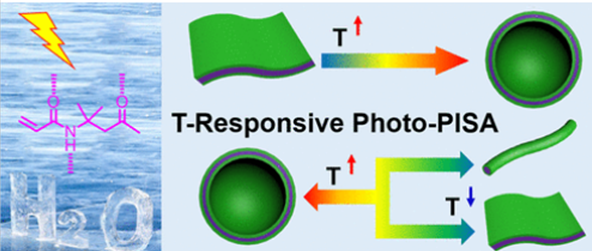
We report an updated polymerization-induced thermal self-assembly (PITSA) [Figg, C. A.; et al. Chem. Sci. 2015, 6, 1230]. The concept is validated using visible light initiated RAFT aqueous dispersion polymerization of diacetone acrylamide monomer at 25 – 70 °C. This PITSA formulation produces block copolymer lamellae at 25 °C while the copolymer morphology evolves from spheres to worms to vesicles during polymerization at 60 °C, which is above the lower critical solution chain length (LCSCL) of the core-forming block. Particle shape and size uniformity can be controlled by reaction temperature using a single photo-PISA formulation. Vesicles-to-lamellae and vesicles-to-worms transitions are achieved in situ upon cooling reaction dispersions (70 °C) to 25 °C, leading to the transformation of initially free-flowing liquids to physical hydrogels. Moreover, reversible thermoresponsive lamellae-to-vesicles-to-lamellae and worms-to-vesicles-to-worms transitions of as-synthesized nanoparticles are achieved in dilution in a heating–cooling cycle. This thermoresponsive photo-PISA formulation updates Figg’s PITSA protocol mainly in three aspects: (1) the absence of LCST limitation, (2) user-friendly control of particle shape and size uniformity by reaction temperature using a single photo-PISA formulation, and (3) reversible thermoresponsive transition of the ketone-functionalized vesicles to customer-guided lamellae or worms.
链接:https://pubs.acs.org/doi/10.1021/acs.macromol.8b02490