
Polyphosphoester-Camptothecin Prodrug with Reduction-Response Prepared via Michael Addition Polymerization and Click Reaction
Xueqiong Du, Yue Sun, Mingzu Zhang, Jinlin He, and Peihong Ni*(倪沛红)
College of Chemistry, Chemical Engineering and Materials Science, State and Local Joint Engineering Laboratory for Novel Functional Polymeric Materials, Jiangsu Key Laboratory of Advanced Functional Polymer Design and Application, Suzhou Key Laboratory of Macromolecular Design and Precision Synthesis, Soochow University, Suzhou 215123, P. R. China
ACS Appl. Mater. Interfaces, 2017, 9 (16), 13939--13949
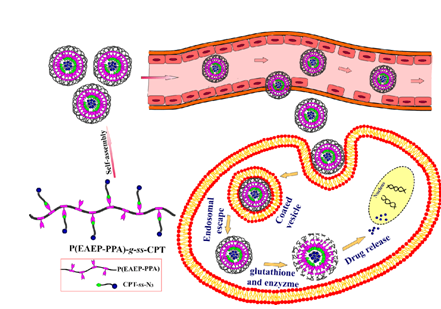
Polyphosphoesters (PPEs), as potential candidates for biocompatible and biodegradable polymers, play an important role in material science. Various synthetic methods have been employed in the preparation of PPEs such as polycondensation, polyaddition, ringopening polymerization, and olefin metathesis polymerization. In this study, a series of linear PPEs has been prepared via one-step Michael addition polymerization. Subsequently, camptothecin (CPT) derivatives containing disulfide bonds and azido groups were linked onto the side chain of the PPE through Cu(I)-catalyzed azidealkyne cyclo-addition “click” chemistry to yield a reduction-responsive polymeric prodrug P(EAEP-PPA)-g-ss-CPT. The chemical structures were characterized by nuclear magnetic resonance spectroscopy, gel permeation chromatography, Fourier transform infrared, ultraviolet−visible spectrophotometer, and high performance liquid chromatograph analyses, respectively. The amphiphilic prodrug could self-assemble into micelles in aqueous solution. The average particle size and morphology of the prodrug micelles were measured by dynamic light scattering and transmission electron microscopy, respectively. The results of size change under different conditions indicate that the micelles possess a favorable stability in physiological conditions and can be degraded in reductive medium. Moreover, the studies of in vitro drug release behavior confirm the reduction-responsive degradation of the prodrug micelles. A methyl thiazolyl tetrazolium assay verifies the good biocompatibility of P(EAEP-PPA) not only for normal cells, but also for tumor cells. The results of cytotoxicity and the intracellular uptake about prodrug micelles further demonstrate that the prodrug micelles can efficiently release CPT into 4T1 or HepG2 cells to inhibit the cell proliferation. All these results show that the polyphosphoester-based prodrug can be used for triggered drug delivery system in cancer treatment.S
链接:http://pubs.acs.org/doi/10.1021/acsami.7b02281