
From Dehydrogenation to Derivatization: Functionalization of Alkanes and Alkyl Groups by Molecular Catalysis
Xinxin Tang(汤锌锌)1, Lan Gan2, Juntao Liu2,3, Guixia Liu2, Zheng Huang(黄正)2,3*
1Key Laboratory of Organic Synthesis of Jiangsu Province, Innovation Center for Advanced Polymer Materials, College of Chemistry, Chemical Engineering and Materials Science, Soochow University, Suzhou 215123, China
2The State Key Laboratory of Organometallic Chemistry, Shanghai Institute of Organic Chemistry, University of Chinese Academy of Sciences, Chinese Academy of Sciences, Shanghai 200032, China
3School of Chemistry and Materials Science, Hangzhou Institute of Advanced Study, University of Chinese Academy of Sciences, Hangzhou 310024, China
J. Am. Chem. Soc. 2026, 148, 38531-38548
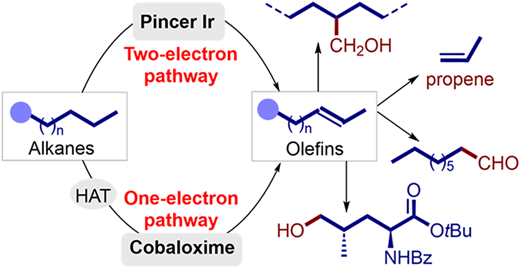
Abstract: Alkane dehydrogenation has evolved from a fundamental organometallic challenge into a transformative technology for upgrading abundant hydrocarbon feedstocks and modifying complex molecules. This Perspective charts the evolution of modern alkane dehydrogenation, emphasizing the strategic divergence between well-established two-electron pathways and emerging radical-mediated reaction manifolds. For the dehydrogenation of structurally unbiased simple alkanes, research remains centered on noble-metal-based molecular catalysts, represented by pincer-transition-metal systems, where activity and regioselectivity are not only governed by catalysts’ first coordination sphere but also subtly affected by ligands’ scaffold. In contrast, for the dehydrogenation of hydrocarbons with electronically or thermodynamically differentiated C(sp3)-H bonds, a complementary paradigm has emerged in which reactivity is mainly dictated by the intrinsic properties of substrates. The interplay of bond dissociation energies (BDEs) and bond polarity can be harnessed by a diverse array of hydrogen atom transfer (HAT) reagents (or catalysts). We discuss how these two distinct mechanisms dictate the scope of both the dehydrogenation and dehydrogenation-triggered derivatization, which extends beyond small alkane functionalizations to controlled upcycling of macromolecular polyolefins. By analyzing the interplay between thermodynamic constraints, catalyst sustainability, and process integration, we outline a forward-looking roadmap for next-generation catalytic dehydrogenation systems.
Article information: https://doi.org/10.1021/jacs.6c11696