
Asymmetric Conjugated Molecule Co-Deposition for High-Performance HTL-Free Carbon-Based Perovskite Solar Cells
Yixin Cao1, Qinrong Cheng(成沁蓉)1*, Yunxiu Shen(沈赟秀)1*, Jiachen Zhang1, Nuo Xu1, Junyuan Ding1, Zhiyun Cao1, Haiyang Chen1, Guiying Xu1, Tiankai Zhang2, Yaowen Li(李耀文)1,3*
1Laboratory of Advanced Optoelectronic Materials, Suzhou Key Laboratory of Novel Semiconductor-optoelectronics Materials and Devices, State Key Laboratory of Bioinspired Interfacial Materials Science, College of Chemistry, Chemical Engineering and Materials Science, Soochow University, Suzhou, China
2School of Materials Science and Engineering, Southeast University, Nanjing, China
3Jiangsu Key Laboratory of Advanced Negative Carbon Technologies, Soochow University, Suzhou, China
Angew. Chem. Int. Ed. 2026, 65, e3883037
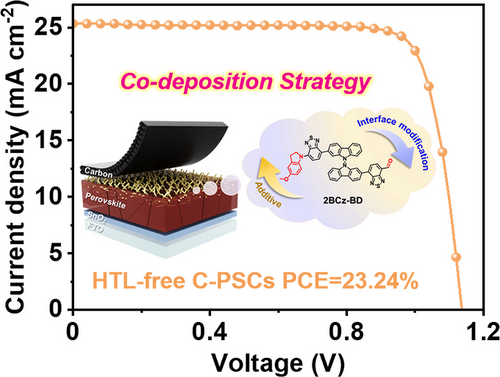
Abstract: Planar hole-transport-layer (HTL)-free carbon-based perovskite solar cells (C-PSCs) show great promise due to their chemical stability and cost-effectiveness. However, the power conversion efficiency (PCE) of HTL-free C-PSCs remains limited by severe interfacial nonradiative recombination and inefficient charge extraction. Herein, we designed an asymmetric D−A−D’−A’ conjugated molecule 2BCz-BD and employed a co-deposition strategy by incorporating 2BCz-BD into the perovskite precursor solution during film fabrication. The coordination ability of 2BCz-BD regulates perovskite crystallization and passivates surface defects, thereby suppressing interfacial non-radiative recombination. The favored p-type semiconducting characters also optimize energy-level alignment to enhance charge extraction. Additionally, the large dipole moment of 2BCz-BD induces an ordered orientation on the perovskite surface, serving as a template for controlled carbon electrode deposition and enabling high-quality electrode fabrication. As a result, small-area (0.062 cm2 ) and large-area (1.004 cm2 ) devices achieved remarkable PCEs of 23.24% and 22.09%, respectively. The unencapsulated devices retained over 90.4% of their initial PCE after 3100 h of operation.
Article information:https://doi.org/10.1002/anie.3883037