
Universal Sacrificial Coordination Strategy for ALD-Resilient SAMs Achieving High-Performance Perovskite/Organic Tandem Solar Cells
Jixiang Yuan1, Denghui Ma2, Weijie Chen(陈炜杰)1*, Pengpeng Dong1, Zhen Fu3, Jialei Zheng1, Ziyue Wang1, Haiyang Chen1, Guiying Xu1, Shengyu Li1, Xiaotao Hao3, Yaowen Li(李耀文)1*
1Laboratory of Advanced Optoelectronic Materials, Suzhou Key Laboratory of Novel Semiconductor-Optoelectronics Materials and Devices, State Key Laboratory of Bioinspired Interfacial Materials Science, College of Chemistry, Chemical Engineering and Materials Science, Soochow University, Suzhou, China
2College of New Energy, Ningbo University of Technology, Ningbo, China
3School of Physics, State Key Laboratory of Crystal Materials, Shandong University, Jinan, China
Adv. Mater., 2026, 38, e74461
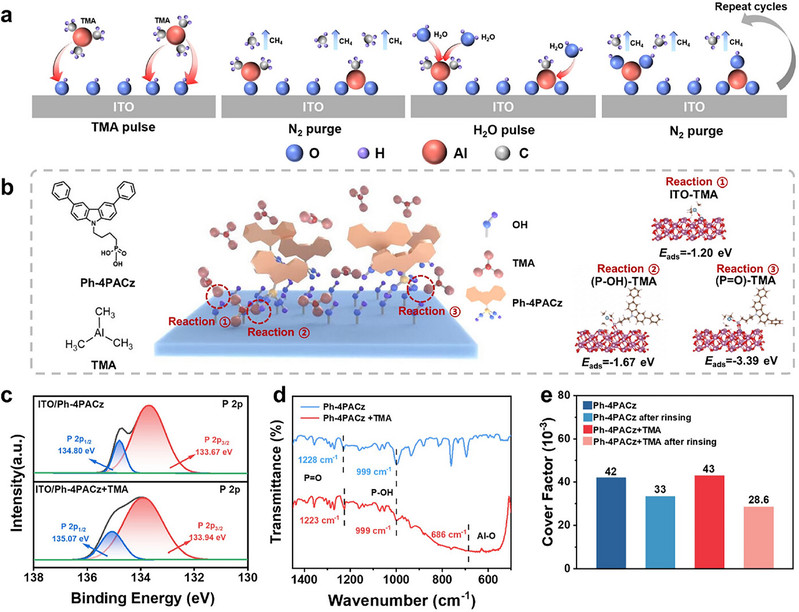
Abstract:Perovskite/organic tandem solar cells (TSCs) offer a compelling route to surpass the Shockley–Queisser limit. In these TSCs, the self-assembled monolayer (SAM), functioning as the hole extraction layer, critically governs the interfacial properties and device performance. Atomic layer deposition (ALD) is a promising technique to grow dense, pinhole-free oxides on SAMs for improved wettability and leakage blocking. However, the detrimental reaction between the ALD precursor and SAM anchoring groups, which causes SAM desorption and severe current leakage, is a widespread and unresolved issue. To address this fundamental challenge, we developed a universal sacrificial coordination (SC) strategy by introducing a multifunctional 6 hydroxy 4 (trifluoromethyl)nicotinic acid (HTFNA) into SAM precursors. HTFNA can suppress SAM molecular aggregation through hydrogen bonding, preferentially react with the ALD precursor to shield the anchored SAM, and increase the work function for favorable interfacial energy level alignment. This strategy demonstrates broad applicability across various SAM-based devices. The champion perovskite/organic TSCs deliver a remarkable efficiency of 27.03% (certified of 26.56%; 0.062 cm2). Moreover, the reinforced SAM/perovskite heterointerface exhibits substantially enhanced adhesion according to the ASTMD3359 standard, leading to superior operational stability (T90 of 1265 h) and ambient storage performance (T90 of 2037 h; ISOS-D-1 protocol).
Article information: https://doi.org/10.1002/adma.74461