
MicroRNA-triggered in situ programmed assembly of photosensitizers with controlled dimension and accelerated kinetics for precise cancer therapy
Jie Sun1, Ling-Hong Xiong2, Ben Zhong Tang(唐本忠)3,4*, Xuewen He(何学文)1*
1State Key Laboratory of Bioinspired Interfacial Materials Science, The Key Lab of Health Chemistry and Molecular Diagnosis of Suzhou, College of Chemistry, Chemical Engineering and Materials Science, Soochow University, Suzhou 215123, China
2School of Public Health, Suzhou Medical College of Soochow University, Soochow University, Suzhou 215123, China
3Guangdong Basic Research Center of Excellence for Aggregate Science, School of Science and Engineering, The Chinese University of Hong Kong, Shenzhen (CUHK-Shenzhen), Shenzhen 518172, China
4Department of Chemistry, Hong Kong Branch of Chinese National Engineering Research Centre for Tissue Restoration and Reconstruction, Institute for Advanced Study and Division of Life Science, The Hong Kong University of Science and Technology, Hong Kong 999077, China
Natl. Sci. Rev., 2026, 13, nwaf424
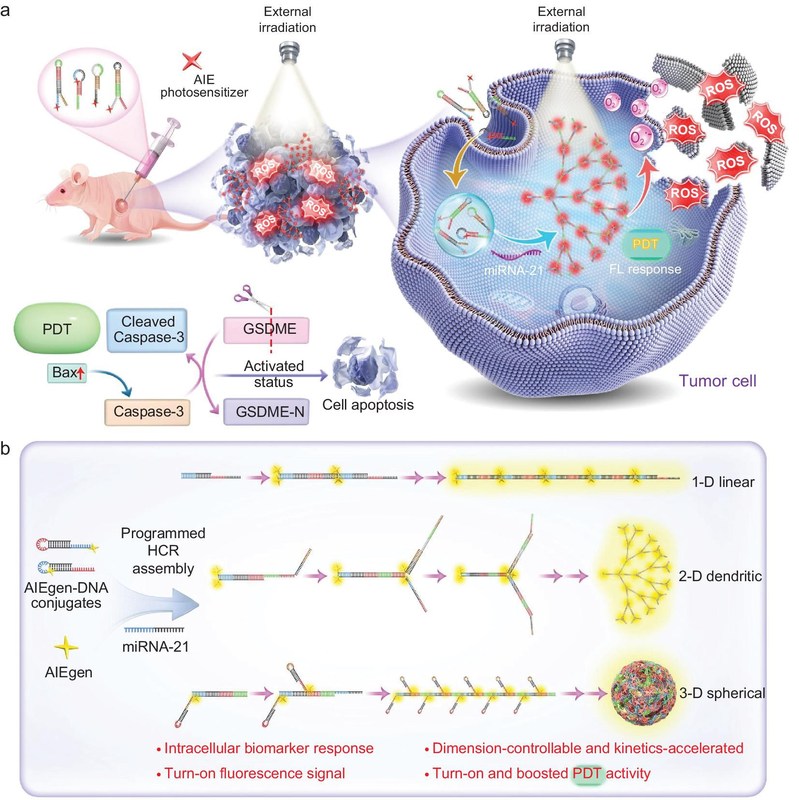
Abstract:The selective in situ synthesis and activation of therapeutic agents within tumor cells are critical for enhancing the targetability and preciseness of cancer therapy. Herein, triggered by specific tumor microRNA biomarkers, programmed hybridization-chain reaction (HCR) assemblies of aggregation-induced emission (AIE) photosensitizers were conducted for the in situ, rapid and controllable synthesis of anticancer agents in cancer cells. Robust fluorescence and photodynamic activities were thus provoked from scratch for precise cancer therapy. By precisely tuning the DNA valency conjugated to the photosensitizer, controllable assembly of one-dimensional linear-, two-dimensional dendritic-, and three-dimensional spherical-type structures were achieved, in which the two-dimensional assembly showed the greatest gains in turn-on fluorescence and reactive oxygen species (ROS) signals. Notably, the photosensitizer conjugation significantly accelerated the HCR kinetics of hairpin DNAs, thereby facilitating the rapid response to microRNA biomarkers within tumor cells and tissues. This microRNA-responsive kinetics-accelerated and dimension-controllable assembly strategy, provides a new avenue for in situ precise cancer theranostics.
Article information: https://doi.org/10.1093/nsr/nwaf424