
Octahedral-coordinated Co3O4 for water electrolysis in acid
Yue Wang1,2, Yujin Ji3, Jing Zhou4,5, Jinxin Chen3, Chenchen Li1, Chendi Zhao1, Jia Ke1, Yutian Xiong1, Sihui Pan3, Wei-Hsiang Huang6,7, Chih-Wen Pao6, Chang-Yang Kuo6,8, Chien-Te Chen6, Youyong Li3, Zhiwei Hu9, Qi Shao(邵琪)1*, Xiaoqing Huang(黄小青)2*
1College of Chemistry, Chemical Engineering and Materials Science, Soochow University, Suzhou, People’s Republic of China
2State Key Laboratory of Physical Chemistry of Solid Surfaces, College of Chemistry and Chemical Engineering, Xiamen University, Xiamen, People’s Republic of China
3Institute of Functional Nano & Soft Materials (FUNSOM), Soochow University, Suzhou, People’s Republic of China
4Zhejiang Institute of Photoelectronics, Zhejiang Normal University, Jinhua, People’s Republic of China
5Zhejiang Institute for Advanced Light Source, Zhejiang Normal University, Jinhua, People’s Republic of China
9Max Planck Institute for Chemical Physics of Solids, Dresden, Germany
Nature, 2026, 656, 370-375
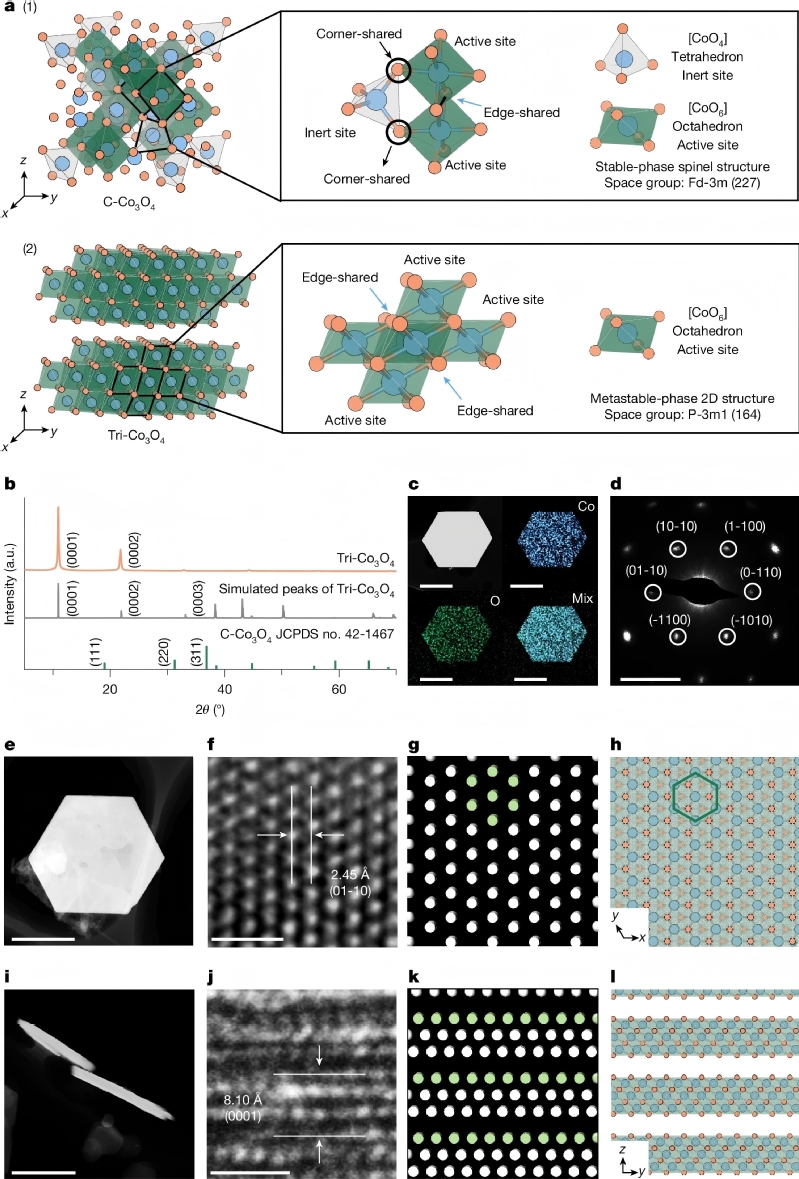
Abstract: The development of highly active and stable non-noble metal oxide catalysts to replace iridium-based materials for efficient acidic water electrolysis is crucial1,2,3. However, traditional spinel cobalt oxide suffers from intrinsic performance limitations from coexistence of inactive tetrahedral (Td) and highly active octahedral (Oh) coordination sites4,5. Here we report a new trigonal-phase Co3O4 (Tri-Co3O4) produced by a vacuum-mediated molten-alkali mechanochemical method, which shows edge-shared [CoO6] octahedral coordination with the space group P-3m1 (164). The three-layer compact structure provides Co2+ and Co3+ located in octahedral coordination in the ratio 1:2. Tri-Co3O4 achieves a low overpotential of 269 millivolts (mV) at the current density of 10 mA cm-2 in the acidic oxygen evolution reaction (OER), 181 mV less than spinel-type Co3O4. It also achieves a current density exceeding 1,800 mA cm-2 at a cell voltage of 1.80 V in proton-exchange membrane water electrolysis (PEMWE) devices. The catalytic mechanism shows that the 2D layered structure with edge-shared octahedral coordination can effectively optimize the adsorption of intermediates and reduce the dissolution of Co, thereby substantially improving the activity and stability of the non-noble metal catalysts.
Article information: https://doi.org/10.1038/s41586-026-10851-7