
Non-Superacid-Catalyzed Preparation of Anion Exchange Membranes for High-Performance Water Electrolyzers
Jinhong Shi1, Zhenquan Chen1, Hanchi Zhang1, Chengxiao Zhou1, Xiukai Shi1, Xi Wang1, Tongxin Yin1,Xingyun Wang1, Zhe Sun(孙哲)1*, Feng Yan(严锋)1,2*
1Jiangsu Engineering Laboratory of Novel Functional Polymeric Materials, Jiangsu Key Laboratory of Advanced Negative Carbon Technologies, Suzhou Key Laboratory of Soft Material and New Energy, College of Chemistry, Chemical Engineering and Materials Science, Soochow University, Suzhou, China
2State Key Laboratory of Advanced Fiber Materials, College of Materials Science and Engineering, Donghua University, Shanghai, China
Angew. Chem. Int. Ed., 2026, 65, e5675182
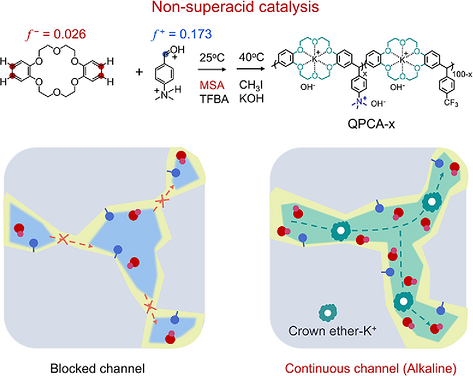
Abstract: Recent advances in anion exchange membrane water electrolyzers (AEMWEs) have been primarily driven by anion exchange membranes (AEMs) prepared via superacid-catalyzed polymerization. However, the reliance on highly corrosive trifluoromethanesulfonic acid (TFSA; pKa =-14.7) employed both as catalyst and solvent poses significant safety, handling, and scalability challenges for industrial AEM manufacturing. Herein, we report a nonsuperacid polymerization strategy for AEMs, utilizing methanesulfonic acid (MSA; pKa =-1.9) to catalyze the Friedel-Crafts alkylation between electrophilic aminobenzaldehyde and electron-rich dibenzo-18-crown-6. Crown ether incorporation expands interchain spacing, thereby facilitating the formation of continuous hydrophilic ion-conducting channels. Furthermore, complexation of potassium ions with crown ether moieties weakens the electrostatic interaction between K+ and OH−, thereby lowering the dissociation energy of the KOH electrolyte. As a result, the optimized QPCA-70 membrane exhibits a high alkaline conductivity of 628.93 mS cm-1 at 80 ◦C and delivers a current density of 8.8 A cm-2 at 2.0 V using a NiFeCo anode. Critically, MSA serves as a safer, more practical, and cost-effective alternative to TFSA: it eliminates the extreme hazards associated with superacid handling, thereby enabling scalable, industrially viable, and low-risk AEM production.
Article information: https://doi.org/10.1002/anie.5675182