
Built-In Self-Regeneration of Platinum Catalysis in Propane Dehydrogenation with Rare-Earth-Modified Zeolites
Liwen Guo1, Guangyuan He2, Zhuoya Dong3, Tianjun Zhang4, Jichao Zhang5, Yanhang Ma3, Donghai Mei2(梅东海)*, Qiming Sun1(孙启明)*, Jihong Yu6(于吉红)*
1Innovation Center for Chemical Science, College of Chemistry, Chemical Engineering and Materials Science, Jiangsu Key Laboratory of Advanced Negative Carbon Technologies, Soochow University, Suzhou, People’s Republic of China
2School of Environmental Science and Engineering and School of Materials Science and Engineering, State Key Laboratory of Separation Membranes and Membrane Processes, Tiangong University, Tianjin, People’s Republic of China
3School of Physical Science and Technology & Shanghai Key Laboratory of High-Resolution Electron Microscopy, Shanghai Tech University, Shanghai, People’s Republic of China
4State Key Laboratory of New Pharmaceutical Preparations and Excipients, College of Chemistry and Materials Science, Hebei University, Baoding, People’s Republic of China
5Shanghai Synchrotron Radiation Facility, Shanghai Advanced Research Institute, Chinese Academy of Sciences, Shanghai, People’s Republic of China
6State Key Laboratory of Inorganic Synthesis and Preparative Chemistry, College of Chemistry, International Center of Future Science, Jilin University, Changchun, People’s Republic of China
Angew. Chem. Int. Ed., 2026, 65, e5533379
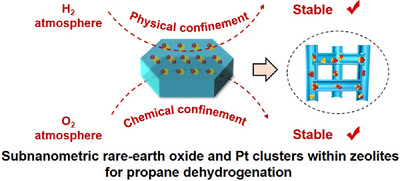
Abstract:Platinum-based zeolite catalysts are among the most effective systems for propane dehydrogenation (PDH), yet their industrial deployment is limited by their poor regenerability under harsh redox cycling. Here, we report a ligand-protected strategy to simultaneously encapsulate subnanometric CeOx and Pt clusters within silicalite-1 (S-1) zeolite. Zeolite confinement stabilizes both Pt and CeOx species under reducing dehydrogenation conditions, while the dynamic and reversible formation of strong Pt–CeOx interactions facilitates the reversible redispersion of Pt species during oxidative regeneration. Notably, the Pt-4CeOx@S-1 catalyst remains fully regenerable after 9 consecutive redox cycles and sustained operation over 5000 min at 600°C. Even after steam treatment at 600°C, the catalyst fully recovers its activity through simple calcination–reduction, demonstrating outstanding structural durability under industrially relevant conditions. Integrated theoretical and experimental evidence shows that confinement within the zeolite framework allows CeOx to dynamically capture mobile PtOx via Pt–O‒Ce bond formation, facilitating atomic-scale Pt redispersion under oxidative conditions. This work offers a generalizable strategy for constructing redox-adaptive catalyst architectures with built-in self-regeneration, advancing the design of robust zeolite-based catalysts for high-temperature and cyclic catalytic processes.
Article information: https://doi.org/10.1002/anie.5533379