
Adaptive Mg2+-Gating Membranes for Battery-Grade Lithium Extraction
Zebin Zhu1, Yijun Qian2(钱翊钧)*, Haoqing Ji2, Ziyi Gu2*, Chenglin Yan(晏成林)2,3*, Jianmei Lu(路建美)1*
1College of Chemistry, Chemical Engineering and Materials Science, Soochow University, Suzhou, China
2College of Energy, Key Laboratory of Core Technology of High Specific Energy Battery and Key Materials for Petroleum and Chemical Industry, Soochow University, Suzhou, China
3School of Petrochemical Engineering, Changzhou University, Changzhou, China
Angew. Chem. Int. Ed., 2026, 65, e2943588
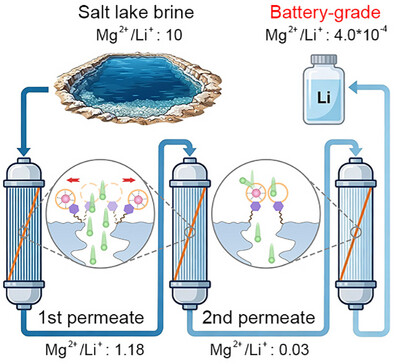
Abstract: Nanofiltration technology shows promise for lithium extraction from salt lakes, yet the fixed nanochannel size of conventional membranes proves insufficient for the complex demands of multi-stage separation processes, especially given the drastic variations in Mg2+/Li+ ratios. To address this issue, 4’-Aminobenzo 15-crown-5-ether (AB-15C5) macrocycles were grafted onto the surface of polyamide (PA) membranes to fabricate adaptive Mg2+-gating membranes (PA-15C5 membranes). The adaptive Mg2+-gating effect enables responsive dimensional switching of nanochannels through spatial rearrangement of crown ether under varying Mg2+ concentrations, as evidenced by experimental confirmation achieved through molecular weight cutoff (MWCO) testing and Zeta potential analyses under ionic modulation conditions. Systematic theoretical validation from density functional theory (DFT) calculations and molecular dynamics (MD) simulations further elaborates on this gating effect. This gating effect converts competing Mg2+ ions into a separation advantage and extends applicability to ultralow Mg2+ concentrations, achieving a Li+/Mg2+ separation factor of 214.9 at a Mg2+/Li+ molar ratio of 0.01. The three-stage nanofiltration process effectively reduced the Mg2+/Li+ ratio in brine to 4.0 *10-4 , while achieving the extraction of battery-grade lithium with a purity of 99.97%. This performance surpasses most reported state-of-the-art, thereby establishing a novel paradigm for deploying adaptive gating membranes in lithium extraction from salt-lake brines.
Article information: https://doi.org/10.1002/anie.2943588