
Ultra-broadband optical amplification at telecommunication wavelengths achieved by bismuth-activated lead iodide perovskites†
Yang Zhou a, Zi-Jun Yong a, Wei Zhang b, Ju-Ping Ma a, Aditya Sadhanala,c Ya-Meng Chen a, Bo-Mei Liu a, Yi Zhou a, Bo Songa and Hong-Tao Sun*a(孙洪涛)
a College of Chemistry, Chemical Engineering and Materials Science,
State and Local Joint Engineering Laboratory for Novel Functional Polymeric Materials, Soochow University, Suzhou 215123, China.
b Advanced Technology Institute, University of Surrey, Guildford GU2 7XH, UK
c Cavendish Laboratory, Department of Physics, University of Cambridge, 19 JJ Thomson Avenue, Cambridge CB3 0HE, UK
J. Mater. Chem. C,2017, 5, 2591--2596
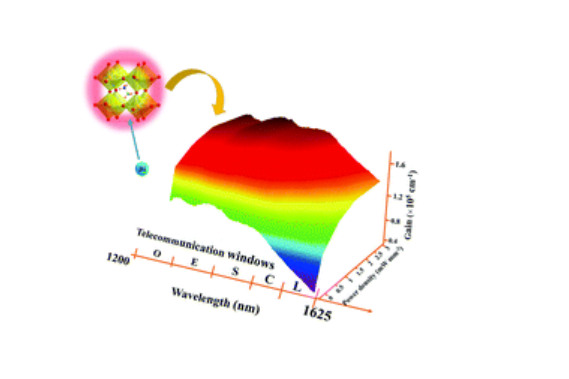
It is extremely difficult to achieve hybrid halide perovskite semiconductors with luminescence at wavelengths longer than 1.0 μm, because of the inherent limitation of their band gaps. We show herein that solution-processable, Bi-activated, high-quality MAPbI3 films can be adopted as a new gain medium operating in the whole telecommunication window of 1260–1625 nm. Additionally, the structural and optical properties of Bi doped MAPbI3 have been investigated. The results indicate that the NIR PL originates from the structural defects induced by Bi. Finally, we accomplished optical amplification in the whole telecommunication window by using Bi-doped MAPbI3 films, which represents the first work where such a performance is attained among lead halide perovskites and Bi-doped photonic films. This work opens up exciting possibilities of using perovskite semiconducting materials as gain media for optical amplifiers and lasers operating in the telecommunication window.
链接:http://pubs.rsc.org/en/content/articlelanding/2017/tc/c6tc05539g#!divAbstract