
Monodisperse Ultrasmall Manganese-Doped Multimetallic Oxysulfide Nanoparticles as Highly Efficient Oxygen Reduction Electrocatalyst
†,†(王祥),†,†,†,†,‡, and†(吴涛)
†College of Chemistry, Chemical Engineering and Materials Science,Soochow University,Suzhou,Jiangsu215123,China
‡College of Materials and Chemical Engineering, Hubei Provincial Collaborative Innovation Center for New Energy Microgrid, Key Laboratory of Inorganic Nonmetallic Crystalline and Energy Conversion Materials,China Three Gorges University,Yichang,Hubei443002,China
ACS Appl. Mater. Interfaces,2018,10(16), 13413--13424
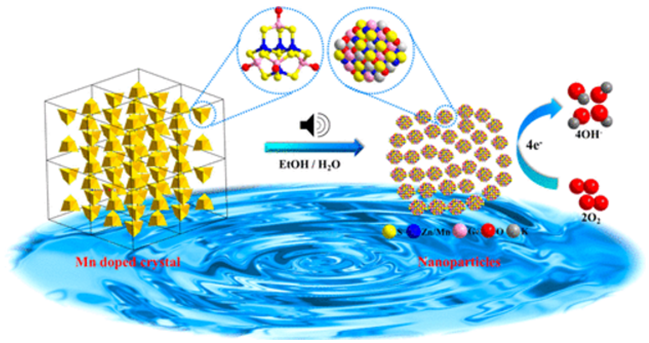
The highly efficient and cheap non-Pt-based electrocatalysts such as transition-based catalysts prepared via facile methods for oxygen reduction reaction (ORR) are desirable for large-scale practical industry applications in energy conversion and storage systems. Herein, we report a straightforward top-down synthesis of monodisperse ultrasmall manganese-doped multimetallic (ZnGe) oxysulfide nanoparticles (NPs) as an efficient ORR electrocatalyst by simple ultrasonic treatment of the Mn-doped Zn–Ge–S chalcogenidometalate crystal precursors in H2O/EtOH for only 1 h at room temperature. Thus obtained ultrasmall monodisperse Mn-doped oxysulfide NPs with ultralow Mn loading level (3.92 wt %) not only exhibit comparable onset and half-wave potential (0.92 and 0.86 V vs reversible hydrogen electrode, respectively) to the commercial 20 wt % Pt/C but also exceptionally high metal mass activity (189 mA/mg at 0.8 V) and good methanol tolerance. A combination of transmission electron microscopy, scanning electron microscopy, X-ray photoelectron spectroscopy, and electrochemical analysis demonstrated that the homogenous distribution of a large amount of Mn(III) on the surface of NPs mainly accounts for the high ORR activity. We believe that this simple synthesis of Mn-doped multimetallic (ZnGe) oxysulfide NPs derived from chalcogenidometalates will open a new route to explore the utilization of discrete-cluster-based chalcogenidometalates as novel non-Pt electrocatalysts for energy applications and provide a facile way to realize the effective reduction of the amount of catalyst while keeping desired catalytic performances.
链接:https://pubs.acs.org/doi/abs/10.1021/acsami.7b19498