
Electronic-resonance enhanced molecule for perovskite solar cells
Xiaoxiao Wu1, Wenwen Kou1, Zewei Li4, Tiankai Zhang(张天恺)3*, Guiying Xu1, Busheng Zhang4, Heyi Yang5, Shengyu Li1, Yunxiu Shen1, Tingting Xu1, Yeyong Wu1, Yue Yin1, Haiyang Chen1, Qinrong Cheng1,6, Xian-Kai Chen(陈先凯)4*, Yaowen Li(李耀文)1,2*, Yongfang Li1,2,7
1Laboratory of Advanced Optoelectronic Materials, Suzhou Laboratory, Suzhou Key Laboratory of Novel Semiconductor-optoelectronics Materials and Devices, State Key Laboratory of Bioinspired Interfacial Materials Science, College of Chemistry, Chemical Engineering and Materials Science, Soochow University, Suzhou 215123, P. R. China
2Jiangsu Key Laboratory of Advanced Negative Carbon Technologies, Soochow University, Suzhou, 215123, Jiangsu, P. R. China
3School of Materials Science and Engineering, Southeast University, Nanjing, 211189, China
4Institute of Functional Nano & Soft Materials (FUNSOM), Soochow University, Suzhou, Jiangsu 215123, P.R. China
5Center of Advanced Optoelectronic Materials, College of Materials and Environmental Engineering, Hangzhou Dianzi University, Hangzhou 310018, China
6Suzhou Sunflex New Energy Company Limited, Suzhou 215100, China
7Beijing National Laboratory for Molecular Sciences; CAS Key Laboratory of Organic Solids, Institute of Chemistry, Chinese Academy of Sciences, Beijing 100190, P. R. China
Nature,2026
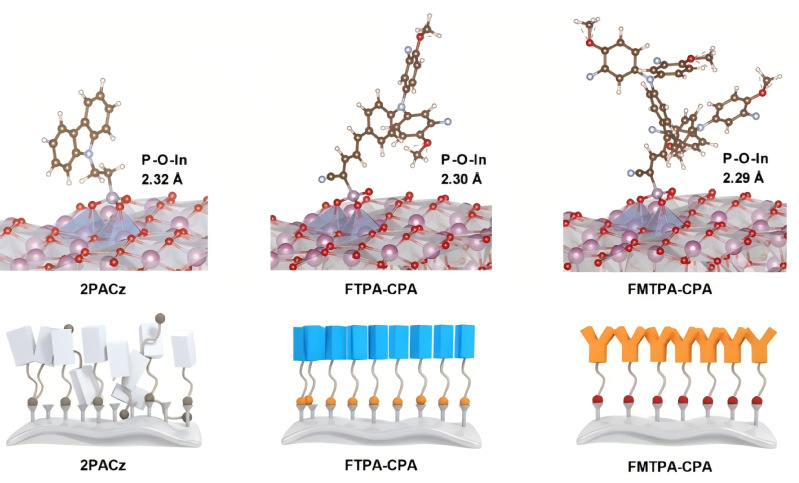
Abstract: Self-assembly monolayers (SAMs), which anchor to transparent conductive oxide (TCO) substrate and form an interfacial molecular dipole to extract carriers from perovskite layer, has promoted a stepwise improvement in efficiency of perovskite solar cells (pero-SCs).1-5 However, the limited intrinsic bonding strength due to constrained electron density on coordination sites incurs SAMs desorption and compromises charge extraction under operational stressors, posing a notable challenge to their long-term stability.6,7 To address this, we design a SAM with donor-acceptor-donor (D-A-D) resonant molecular structure, in which the electronic resonance increases the negative charge density at the acceptor anchoring group, significantly strengthening the phosphonic acid-indium tin oxide (ITO) anchoring bond and preventing the SAM desorption during operation. The device applying D-A-D resonant SAM possesses remarkable operational stability with negligible decay under maximum-power-point tracking (MPPT) at 85±5 °C for 1,080 h, maintains >93% after 1,080 h under metal halide (MH) lamp illumination (100 mW cm−2, 4.4% UV inside) at 85±5 °C and also retains >98% after 720 repetitive thermal cycles between −40 °C and 85 °C. Concurrently, the resonance induced charge delocalization facilitates efficient carrier transport, realizing a certified power conversion efficiencies (PCEs) of 27.69% on 0.063 cm2 devices and 23.63% with aperture area of 15.64 cm2. The certified efficiency of 26.64% is also realized on flexible substrates (0.063 cm2), demonstrating the universality of this approach across different types of substrates.
Article information: https://doi.org/10.1038/s41586-026-10919-4