
Efficiency, stability and scalable deployment of organic photovoltaics
Juan Zhu(朱娟)1, Haiyang Chen(陈海阳)1*, Rui Zhang2 Xiaozhang Zhu3, Yanming Sun4, Feng Gao5, Yongfang Li1,6 , Yaowen Li(李耀文)1*
1Laboratory of Advanced Optoelectronic Materials, Suzhou Key Laboratory of Novel Semiconductor-optoelectronics Materials and Devices, State Key Laboratory of Bioinspired Interfacial Materials Science, College of Chemistry, Chemical Engineering and Materials Science, Soochow University, Suzhou, China
2State Key Laboratory of Bioinspired Interfacial Materials Science, Institute of Functional Nano and Soft Materials (FUNSOM), Soochow University, Suzhou, China
3Research Center for Future Organic Optoelectronics, Global Institute of Future Technology (GIFT), Shanghai Jiao Tong University, Shanghai, China
4School of Chemistry, Beihang University, Beijing, China
5Department of Physics, Chemistry and Biology (IFM), Linköping University, Linköping, Sweden
6Beijing National Laboratory for Molecular Sciences, CAS Key Laboratory for Organic Solids, Institute of Chemistry, Chinese Academy of Sciences, Beijing, China
Nature Reviews Clean Technology, 2026
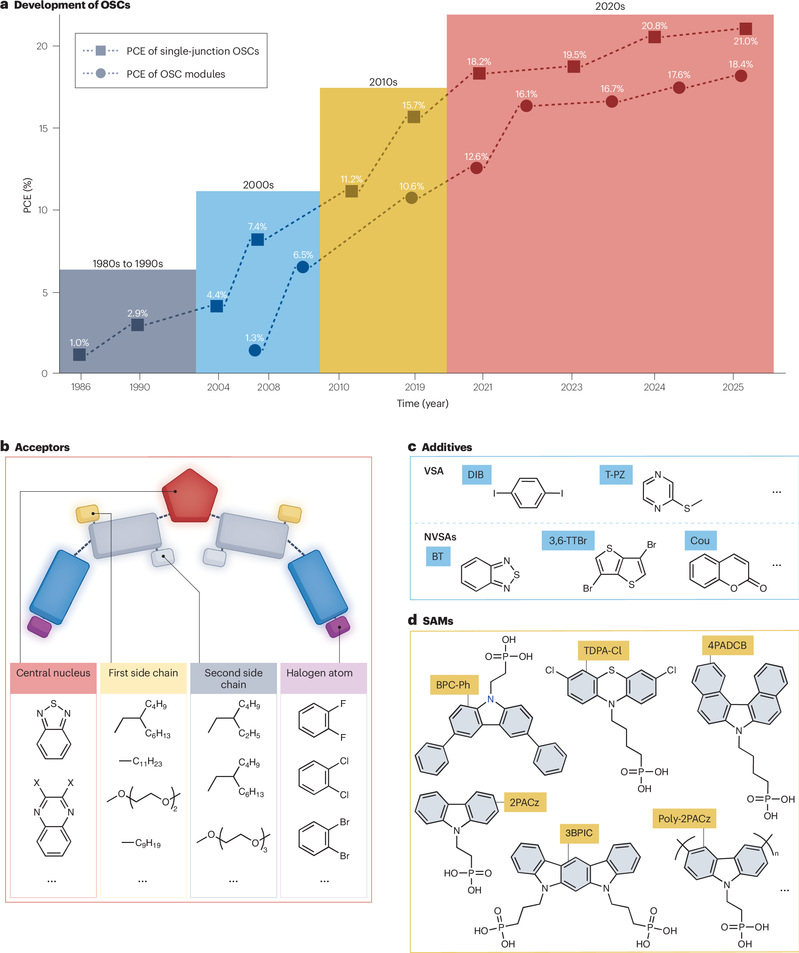
Abstract: Organic photovoltaics (OPVs) can have certified power conversion efficiencies exceeding 21%, placing them within a performance range relevant for commercialization. In this Review, we analyse OPV development through efficiency optimization, long-term operational stability, scalable processing and manufacturing cost. Strategies in active material design, additive engineering, self-assembled interlayers and synthetic-complexity control are summarized, highlighting how molecular structure, aggregation behaviour, interfacial energetics and material cost collectively govern device performance and degradation. Stability-limiting mechanisms arise across materials, bulk-heterojunction morphology and buried interfaces, underscoring the need to address the system-level coupling between these factors under realistic operating conditions. Developing OPVs towards real-world deployment will require environmentally friendly processability, thick-film tolerance, fluid-dynamics-regulated coating, mechanical flexibility and semi-transparent device architectures. Large-area modules exceeding 10 cm2 with power conversion efficiencies of ≥15% demonstrate progress towards scalable fabrication. By combining progress across materials, interfaces, device architectures and cost-aware design, applications such as wearable electronics, indoor energy harvesting, building-integrated photovoltaics and agrivoltaic systems can be realized.
Article information: https://doi.org/10.1038/s44359-026-00202-0