
Flexible Lithium-Ion Fiber Battery by the Regular Stacking of Two-Dimensional Titanium Oxide Nanosheets Hybridized with Reduced Graphene Oxide
Tatsumasa Hoshide†‡, Yuanchuan Zheng†, Junyu Hou†, Zhiqiang Wang†, Qingwen Li§, Zhigang Zhao*§(赵志刚), Renzhi Ma‡, Takayoshi Sasaki‡, and Fengxia Geng*†(耿凤霞)
† College of Chemistry, Chemical Engineering and Materials Science, Soochow University, Suzhou 215123, China
‡ International Center for Materials Nanoarchitectonics, National Institute for Materials Science, 1-1 Namiki, Tsukuba, Ibaraki 305-0044, Japan
§ Suzhou Institute of Nanotech and Nanobionics, Chinese Academy of Sciences, 398 Ruoshui Road, Suzhou Industry Park, Suzhou 215123, China
Nano Lett., 2017, 17 (6), 3543--3549
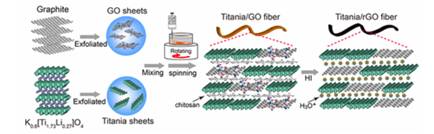
Increasing interest has recently been devoted to developing small, rapid, and portable electronic devices; thus, it is becoming critically important to provide matching light and flexible energy-storage systems to power them. To this end, compared with the inevitable drawbacks of being bulky, heavy, and rigid for traditional planar sandwiched structures, linear fiber-shaped lithium-ion batteries (LIB) have become increasingly important owing to their combined superiorities of miniaturization, adaptability, and weavability, the progress of which being heavily dependent on the development of new fiber-shaped electrodes. Here, we report a novel fiber battery electrode based on the most widely used LIB material, titanium oxide, which is processed into two-dimensional nanosheets and assembled into a macroscopic fiber by a scalable wet-spinning process. The titania sheets are regularly stacked and conformally hybridized in situ with reduced graphene oxide (rGO), thereby serving as efficient current collectors, which endows the novel fiber electrode with excellent integrated mechanical properties combined with superior battery performances in terms of linear densities, rate capabilities, and cyclic behaviors. The present study clearly demonstrates a new material-design paradigm toward novel fiber electrodes by assembling metal oxide nanosheets into an ordered macroscopic structure, which would represent the most-promising solution to advanced flexible energy-storage systems.
链接:http://pubs.acs.org/doi/abs/10.1021/acs.nanolett.7b00623