
Selenium-Containing Medium Bandgap Copolymer for Bulk Heterojunction Polymer Solar Cells with High Efficiency of 9.8%
Zhuo Xu†∥, Qunping Fan†∥, Xiangyi Meng‡, Xia Guo*†(国霞), Wenyan Su†, Wei Ma‡, Maojie Zhang*†(张茂杰), and Yongfang Li†§
† State and Local Joint Engineering Laboratory for Novel Functional Polymeric Materials, Laboratory of Advanced Optoelectronic Materials, College of Chemistry, Chemical Engineering and Materials Science, Soochow University, Suzhou 215123, People’s Republic of China
‡ State Key Laboratory for Mechanical Behavior of Materials, Xi’an Jiaotong University, Xi’an 710049, People’s Republic of China
§ Beijing National Laboratory for Molecular Sciences, CAS Key Laboratory of Organic Solids, Institute of Chemistry, Chinese Academy of Sciences, Beijing 100190, China
Chem. Mater., 2017, 29 (11), 4811--4818
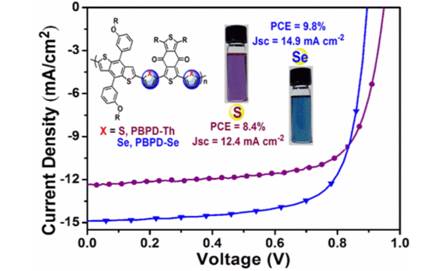
In this work, a new D–A copolymer based on m-alkoxyphenyl substituted benzodithiophene (BDT-m-OP) as donor unit and benzo[1,2-c:4,5-c′]dithiophene-4,8-dione (BDD) as acceptor unit was designed and synthesized, in which selenophene unit as π-conjugated spacer was incorporated into the polymer backbone to broaden the absorption spectrum, enhance the charge transport properties, and even improve the photovoltaic properties. Compared with PBPD-Th with thiophene as π-conjugated spacer, PBPD-Se exhibits an evidently extended absorption spectrum and an enhanced hole mobility with a slightly raised HOMO energy level. The PBPD-Se:PC71BM-based PSCs exhibits a significantly improved PCE of 9.8% with an enhanced Jsc of 14.9 mA cm–2 and a slightly lower Voc of 0.90 V in comparison with a PCE of 8.4% with a Voc of 0.95 V and a Jsc of 12.4 mA cm–2 for PBPD-Th:PC71BM-based devices. These results indicate that the rational selection of π-conjugated spacer in the D–A copolymer backbone is very essential to achieve high efficiency PSCs.
链接:http://pubs.acs.org/doi/abs/10.1021/acs.chemmater.7b00729