
Intracellular Delivery Platform for “Recalcitrant” Cells: When Polymeric Carrier Marries Photoporation
Jingxian Wu†, Hui Xue†, Zhonglin Lyu†, Zhenhua Li†, Yangcui Qu†, Yajun Xu‡, Lei Wang*†(王蕾), Qian Yu*†(于谦), and Hong Chen†
† State and Local Joint Engineering Laboratory for Novel Functional Polymeric Materials, College of Chemistry, Chemical Engineering and Materials Science, Soochow University, 199 Ren’ai Road, Suzhou 215123, P. R. China
‡Jiangsu Biosurf biotech Co. Ltd, 218 Xinghu Street, Suzhou215123, P. R. China
ACS Appl. Mater. Interfaces, 2017, 9 (26), 21593--21598
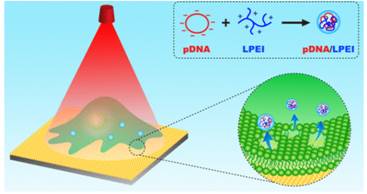
The intracellular delivery of exogenous macromolecules is of great interest for both fundamental biological research and clinical applications. Although traditional delivery systems based on either carrier mediation or membrane disruption have some advantages; however, they are generally limited with respect to delivery efficiency and cytotoxicity. Herein, a collaborative intracellular delivery platform with excellent comprehensive performance is developed using polyethylenimine of low molecular weight (LPEI) as a gene carrier in conjunction with a gold nanoparticle layer (GNPL) acting as a photoporation agent. In this system, the LPEI protects the plasmid DNA (pDNA) to avoid possible nuclease degradation, and the GNPL improves the delivery efficiency of the LPEI/pDNA complex to the cells. The collaboration of LPEI and GNPL is shown to give significantly higher transfection efficiencies for hard-to-transfect cells (88.5 ± 9.2% for mouse embryonic fibroblasts, 94.0 ± 6.3% for human umbilical vein endothelial cells) compared to existing techniques without compromising cell viability.
链接:http://pubs.acs.org/doi/abs/10.1021/acsami.7b06201