
Broad-spectrum insecticide detoxification for the protection of managed pollinators
Zuliang Huang1,2,3, Yan Wang1,2,3, Jiakun Guo1,2,3, Suhui Lv4, Jie Gui4, Zhiyuan Zhong(钟志远)1,2,3*, Jing Chen(陈景)4,5*, Chao Deng(邓超)1,2,3*
1Biomedical Polymers Laboratory, College of Chemistry, Chemical Engineering and Materials Science, Soochow University, Suzhou, China
2Jiangsu Key Laboratory of Advanced Functional Polymer Materials, College of Chemistry, Chemical Engineering and Materials Science, Soochow University, Suzhou, China
3Materials Science, and State Key Laboratory of Radiation Medicine and Protection, Soochow University, Suzhou, China
4National Key Laboratory of Technologies for Chinese Medicine Pharmaceutical Process Control and Intelligent Manufacture, Nanjing University of Chinese Medicine, Nanjing, China
5College of Pharmacy, Nanjing University of Chinese Medicine, Nanjing, China
Nat. Sustain., 2026
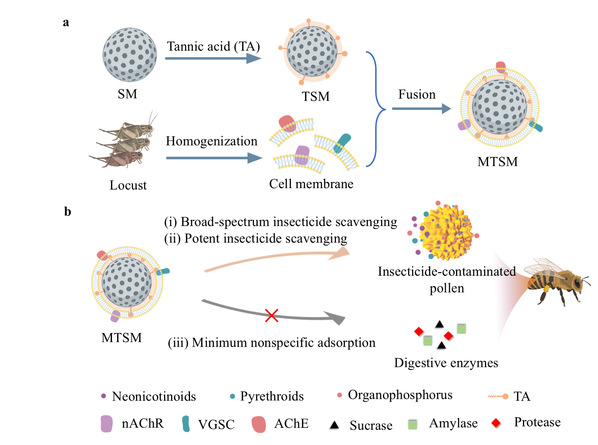
Abstract: Sustainable agriculture relies heavily on various pollinators that support the production and diversity of approximately 75% of global food crops. However, pollinator populations are in sharp decline largely due to insecticide exposure during crop pollination and a lack of effective protective interventions. Here we report a biomimetic detoxification system-mesoporous silica microparticles (MTSMs) coated with locust cell membrane and tannic acid-to protect bumblebees against insecticides. By leveraging π-π stacking and specific enzyme interactions, MTSMs presented high removal efficiency across organophosphate, pyrethroid and neonicotinoid classes, while maintaining minimum non-specific clearance of favourable enzymes predominantly present in the gastrointestinal system of bees. In addition to revealing dose-dependent detoxification capacity towards organophosphate and neonicotinoid insecticides, MTSMs exhibited over 12-h residency in the gastrointestinal tract of bumblebees to facilitate insecticide scavenging, and could be mostly excreted by bees within 48 h, causing no death of bees even at a high concentration of 50 mg ml-1. Environmental safety assessments indicate that MTSMs exhibit no observable inhibition effects on other insect viability (for example, Teleogryllus mitratus and Teleogryllus emma) and leguminous plant morphogenesis, suggesting their potential compatibility with agricultural applications. Overall, MTSMs have the potential to provide efficient broad-spectrum insecticide detoxification for the protection of managed pollinators.
Article information: https://doi.org/10.1038/s41893-026-01867-y