
Engineering Highly Photoefficient and Function-Tunable Molecular Rotary Motors toward Sunlight Responsiveness
JunxuRen1, DaisyR.S.Pooler2,3, Heng Guo1, Yuyang Tu1, Wojciech Danowski3,4, Fan Xu5, Ben L.Feringa3*, Jinyu Sheng(盛金宇)1,3,6,7*
1State Key Laboratory of Bioinspired Interfacial Materials Science & College of Chemistry, Chemical Engineering and Materials Science, Soochow University, Suzhou, Jiangsu 215123, China
2Department of Chemistry, KTH Royal Institute of Technology, Stockholm 10044, Sweden
3Stratingh Institute for Chemistry, Centre for Systems Chemistry, University of Groningen, Groningen 9747 AG, The Netherlands
4Faculty of Chemistry, University of Warsaw, 02-093 Warsaw, Poland
5CAS Key Laboratory of Colloid, Interface and Thermodynamics, Institute of Chemistry, Chinese Academy of Sciences, Beijing 100190, China
6Center of Translational Medicine, The Fourth Affiliated Hospital of Soochow University, Medical Center of Soochow University, Suzhou Dushu Lake Hospital
7Innovation Center for Advanced Polymer Materials, Soochow University, Suzhou, Jiangsu 215123, China
J. Am. Chem. Soc. 2026, 148, 25012-25022
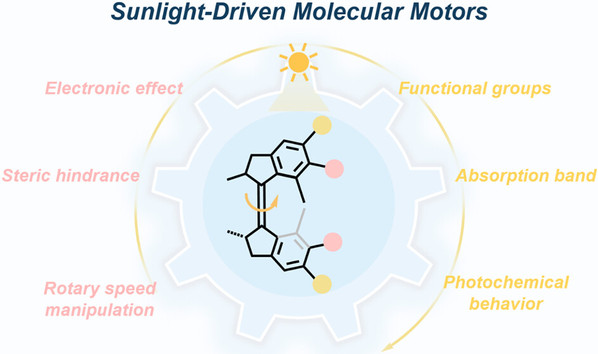
Abstract: The construction of light-driven molecular rotary motors capable of unidirectional rotation holds great promise for the construction of smart, adaptive systems and dynamic materials. Designing molecular structures that combine high photoefficiency, tunable functionality, and robust structural integrity is critical for advancing these applications. Herein, we present a molecular engineering strategy to access a family of highly photoefficient first-generation molecular motors (MMs) bearing diverse functional groups through late-stage modification of a typical motor scaffold. This systematic investigation demonstrates that the photoefficiency, functional properties, and rotary speed of molecular motors can be precisely tuned through relatively simple structural modifications and identifies para-formylation as a key design principle for markedly enhancing the photoefficiency of future motor scaffolds. The photoefficient MMs exhibit exceptional responsiveness to sunlight both in solution and within a polystyrene polymer matrix, opening unique opportunities for the construction of high-performance MMs with tailored functionalities for materials science and dynamic molecular systems. This work expands the synthetic toolbox of molecular machines and inspires future molecular design strategies.
Article information:https://doi.org/10.1021/jacs.6c05225