
σ-Hole Interaction-Driven Enrichment-Catalysis Cascade Reaction in Covalent Organic Cages Enables Ultrahigh-Rate Li-Br2 Batteries
Yixuan Zhu1, Shenxiang Zhang1, Xiwei Cao, Yan Xu1(胥燕)*, Feng Yan1,2(严锋)*
1Jiangsu Engineering Laboratory of Novel Functional Polymeric Materials, Jiangsu Key Laboratory of Advanced Negative Carbon Technologies, Suzhou Key Laboratory of Soft Material and New Energy, College of Chemistry, Chemical Engineering and Materials Science, Soochow University, Suzhou, China
2State Key Laboratory For Modification of Chemical Fiber and Polymer Materials, College of Materials Science and Engineering, Donghua University, Shanghai, China
Adv. Funct. Mater., 2026, 36, e75452
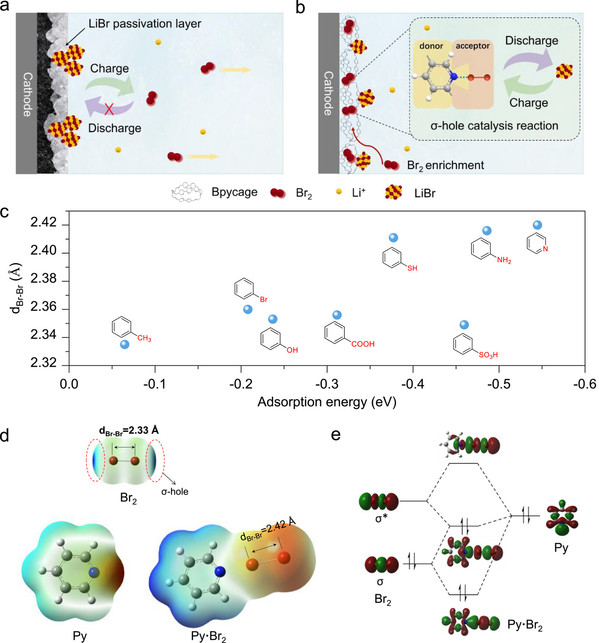
Abstract: Rechargeable lithium-bromine (Li-Br2) battery is a promising battery system due to its high-energy-density (1050 Wh kg−1). However, the practical implementation of this system is hampered by sluggish reduction kinetics of Br2 and severe shuttle effect, leading to poor rate performance and inferior low-temperature performance. Herein, we propose a strategy driven by a σ-hole interaction, which strengthen the electron donation into the σ* antibonding orbital of Br2 to enhance its trapping and promote rapid cathode conversion. As a proof of concept, pyridine units—validated by theoretical calculations as effective σ-hole mediators—were integrated into a structurally engineered covalent organic cage (Bpycage). The Bpycage cathode thereby locally enriches Br2 and accelerates its electrochemical reduction. Benefiting from this design, the Li-Br2@Bpycage battery achieves exceptional rate capability (up to 20 A g−1 or 25 mA cm−2) and long-term stability over 320 cycles at 10 A g−1 (9 mA cm−2), outperforming conventional carbon cathode. Moreover, the σ-hole interaction effectively decreases the freezing point of Br2, enabling stable operation at an ultralow temperature of −45°C, far beyond the limit of −20°C for carbon-based cathodes. This work highlights the potential of molecularly designed organic cages as high-performance cathodes for advanced metal-halogen battery systems.
Article information: https://doi.org/10.1002/adfm.75452