
Impact of cyclic topology: odd–even glass transition temperatures and fluorescence quantum yields in molecularly-defined macrocycles†
Kun Li‡a,Ganquan Jiang‡a, Feng Zhou a, Lishan Li a, Zhengbiao Zhang a,
Zhijun Hu*b(胡志军), Nianchen Zhou*a(周年琛)and Xiulin Zhu*a(朱秀林)
aState and Local Joint Engineering Laboratory for Novel Functional Polymeric Materials, Jiangsu Key Laboratory of Advanced Functional Polymer Design and Application, College of Chemistry, Chemical Engineering and Materials Science, Soochow University, Suzhou215123, P. R. China.
bCenter for Soft Condensed Matter Physics and Interdisciplinary Research, College of Physics, Optoelectronics and Energy & Collaborative Innovation Center of Suzhou Nano Science and Technology, Soochow University, Suzhou 215006, P. R. China.
Polym. Chem., 2017, 8,2686--2692
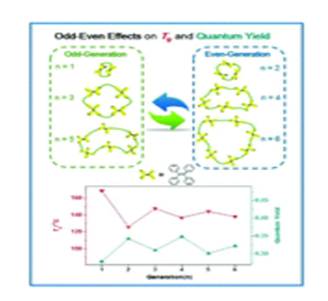
Topological molecular architectures play a crucial role in many physico-chemical properties of materials and biological processes. Herein we synthesized a series of molecularly-defined cyclic oligomers, cyclic-TPEn+1 (n = 1–6), containing tetraphenylethylene (TPE) segments in the main chain by a stepwise chain-growth strategy. The cyclic structure endows the cyclic-TPEn+1 with a higher glass transition temperature (Tg) and quantum yields of aggregation induced emission (AIE) for n = 1 and 2 due to the constraints imposed by the cyclic topology itself. Importantly, the cyclic topology induces odd–even effects on both Tg and photoluminescence quantum yield, arising from the alternation of intermolecular interactions. Hopefully, this work will advance our understanding on the glass transition and AIE mechanism, and finally pave the way for the development of luminogens with a wide variety of functions.
链接:http://pubs.rsc.org/en/content/articlelanding/2017/py/c7py00037e#!divAbstract