
Scalable Synthesis of Uniform Mesoporous Aluminosilicate Microspheres with Controllable Size and Morphology and High Hydrothermal Stability for Efficient Acid Catalysis
Yunqing Li1, Xiangcheng Zhang1, Chao Shang1, Xiangru Wei1, Lei Wu1, Xiaoning Wang1, Winston Duo Wu1, Xiao Dong Chen1, Cordelia Selomulya2, Dongyuan Zhao3, and Zhangxiong Wu1*(吴张雄)
1Particle Engineering Laboratory (PEL), School of Chemical and Environmental Engineering, College of Chemistry, Chemical Engineering and Materials Science, Soochow University, Suzhou, Jiangsu 215123, P. R. China
2School of Chemical Engineering, University of New South Wales, Sydney, New South Wales 2052, Australia
3Department of Chemistry and Laboratory of Advanced Materials, Fudan University, Shanghai 200433, P. R.
ACS Appl. Mater. Interfaces 2020, 12, 21922--21935
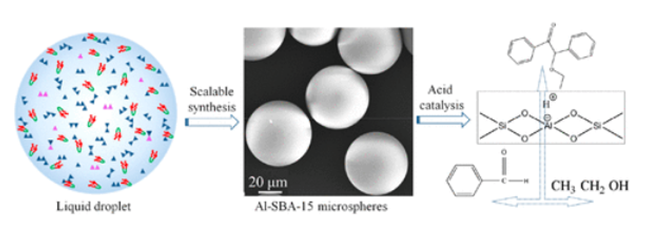
Mesoporous aluminosilicates are promising solid acid catalysts. They are also excellent supports for transition metal catalysts for various catalytic applications. Synthesis of mesoporous aluminosilicates with controllable particle size, morphology, and structure, as well as adjustable acidity and high hydrothermal stability, is very desirable. In this work, we demonstrate the scalable synthesis of Al-SBA-15 microspheres with controllable physicochemical properties by using the microfluidic jet-spray-drying technology. The productivity is up to ∼30 g of dried particles per nozzle per hour. The Al-SBA-15 microspheres possess uniform controllable micron sizes (27.5-70.2 μm), variable surface morphologies, excellent hydrothermal stability (in pure steam at 800 °C), high surface areas (385-464 m2/g), ordered mesopore sizes (5.4-5.8 nm), and desirable acid properties. The dependence of various properties, including particle size, morphology, porosity, pore size, acidity, and hydrothermal stability, of the obtained Al-SBA-15 microspheres on experimental parameters including precursor composition (Si/Al ratio and solid content) and processing conditions (drying and calcination temperatures) is established. A unique morphology transition from smooth to wrinkled microsphere triggered by control of the Si/Al ratio and solid content is observed. The particle formation and morphology-evolution mechanism are discussed. The Al-SBA-15 microspheres exhibit high acid catalytic performance for aldol-condensation reaction between benzaldehyde and ethyl alcohol with a high benzaldehyde conversion (∼56.3%), a fast pseudo-first-order reaction rate (∼0.1344 h-1), and a high cyclic stability, superior to the commercial zeolite acid (H-ZSM-5). Several influencing factors on the catalytic performance of the obtained Al-SBA-15 microspheres are also studied.
链接:https://pubs.acs.org/doi/abs/10.1021/acsami.0c04998