
Mechanochemical Synthesis and Fluorescence Reporting of Conjugated Polymers through Flex-Activation
Xiaohong Huang, Hang Shen(沈行)*, Zhengbiao Zhang(张正彪)*
State and Local Joint Engineering Laboratory for Novel Functional Polymeric Materials, College of Chemistry, Chemical Engineering and Materials Science, Soochow University, Suzhou 215123, China
J. Am. Chem. Soc.2026, 148, 19101–19108
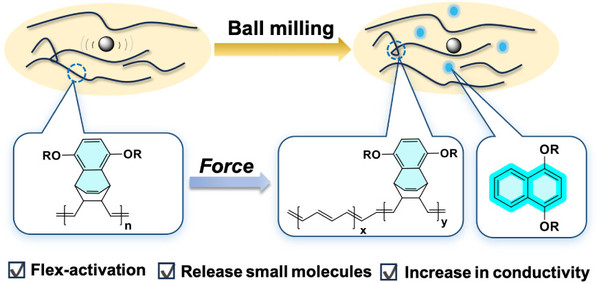
Abstract: Polymer mechanochemistry enables the transduction of mechanical force into chemical signals, providing a versatile approach for the design of adaptive and functional materials. Of particular interest is the mechanochemical generation of conjugated polymers, which holds significant promise for applications in electronics and sensing. However, progress in this area has been hindered by low activation yields and difficult quantification in bulk materials. Herein, we report a flex-activated mechanophore based on benzotricyclodecatriene (BTCD), which undergoes a retro-Diels–Alder reaction via a bond-bending mechanism. Upon ball milling, poly(BTCD) achieves efficient activation, simultaneously releasing the fluorescent reporter 1,4-bis(hexyloxy)naphthalene (BHN) for straightforward quantification and generating semiconducting polyacetylene. The reaction kinetics and activation efficiency show clear dependencies on the milling time and polymer molecular weight. The same flex-activation pathway can be triggered under uniaxial compression, enabling iterative activation in cross-linked networks without macroscopic fracture. By integration of built-in fluorescence reporting with mechanochromic response, this system establishes a multifunctional platform for mechanoresponsive materials. Our work provides a scalable and quantitative strategy to mechanochemically generate functional polyenes directly in bulk polymers, significantly expanding the scope of flex-activated mechanophores.
Article information: https://doi.org/10.1021/jacs.6c02514