
Ligand-Modulated Cobalt-Catalyzed Alkene Carbocarbonylation Unlocks Aliphatic Ketone Synthesis
Ting Zeng1, Liangjie Ruan1, Zhili Cui1, Jixin Wang1, Changrui Nie1, Shulei Ge1, Lin He2(何林),* Jie Li1,3 (李杰)*
1State Key Laboratory of Bioinspired Interfacial Materials Science, College of Chemistry, Chemical Engineering and Materials Science, Soochow University, Suzhou 215123, China
2State Key Laboratory of Low Carbon Catalysis and Carbon Dioxide Utilization, Lanzhou Institute of Chemical Physics (LICP), Chinese Academy of Sciences, Lanzhou 730000, China
3MOE Key Laboratory of GeriatricDiseases and Immunology, Suzhou Key Laboratory of Pathogen Bioscience and Anti-infective Medicine, Soochow University, Suzhou 215123, China
J. Am. Chem. Soc. 2026, 148, 21104–21113
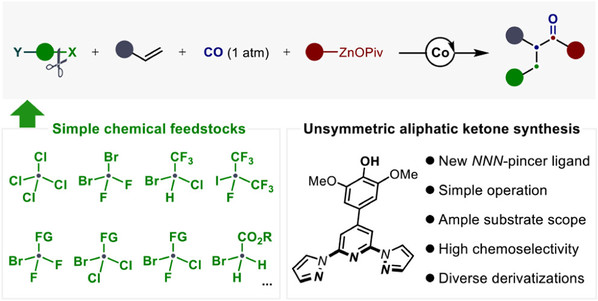
Abstract: Unsymmetric aliphatic ketones are one of the most versatile functional groups and are commonly found in a plethora of organic molecules and bioactive compounds. Yet, a concise construction of aliphatic ketones via a direct carbonylation strategy still remains challenging, particularly when employing alkenes as versatile feedstocks. By the use of a newly developed bispyrazolylpyridine-type NNN-pincer ligand, we herein report a divergent synthesis of unsymmetric aliphatic ketones through cobalt-catalyzed four-component carbocarbonylation of both activated and unactivated alkenes under 1 atm of CO gas. This methodology encompasses a wide range of alkenes, alkylzinc reagents, and alkyl halides. Of particular interest is the use of highly functionalized CCl4, CF2Br2, and their derivatives as the electrophiles, thus affording modular access to structurally diverse aliphatic ketones, which might find potential applications in synthetic and medicinal chemistry. Moreover, this protocol is also distinguished by its simple operation, excellent functional group compatibility, and high regio- and chemoselectivity.
Article information: https://doi.org/10.1021/jacs.6c06343