
Stereoreversed C−OActivation Unlocks All-Carbon Tetrasubstituted Z-AlkeneSynthesis
Kaixin Chen1, Jiali Peng2,4, Jie Lin1, Binjing Hu1, Haihong Chen1, Hongwei Jia3, Changrui Nie1, Zhenbo Mo3(莫贞波),* Xiaotian Qi2(戚孝天)*, Jie Li1(李杰)*
1State Key Laboratory of Bioinspired Interfacial Materials Science, MOE Key Laboratory of Geriatric Diseasesand Immunology, Suzhou Key Laboratory of Pathogen Bioscience and Anti-infective Medicine, College of Chemistry, Chemical Engineering and Materials Science, Soochow University, Suzhou 215123, China
2Engineering Research Center of Organosilicon Compounds & Materials, Ministry of Education, College of Chemistry and Molecular Sciences, Wuhan University, Wuhan 430072 Hubei, China
3State Key Laboratory and Institute of Elemento Organic Chemistry, Frontiers Science Center for New OrganicMatter, College of Chemistry, Nankai University, Tianjin300071, China
4Key Laboratory of Colloidand Interface Chemistry, Ministry of Education, School of Chemistry and Chemical Engineering, Shandong University, Jinan 250100, China
J. Am. Chem. Soc. 2026, 148, 20230−20239
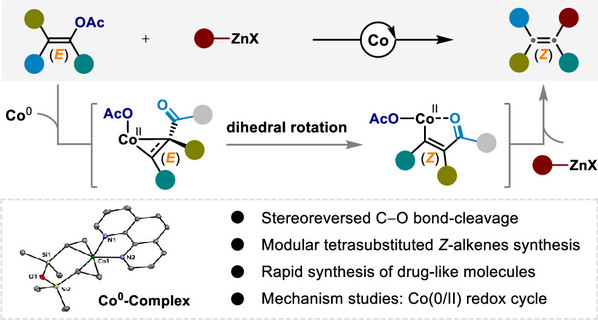
Abstract: Stereochemically defined all-carbon tetrasubstituted alkenes are key structural motifs in various bioactive compounds and organic materials. Owing to the congested nature of the carbon−carbon double bond, controlling regio- and stereochemistry still remains a crucial challenge in modern synthetic chemistry. As such, we herein disclose a practical cobalt-catalyzed stereoselective Negishi cross-coupling between readily available alkenyl acetates and organozinc pivalates through a novel stereoreversed C−O bond-cleavage strategy. Detailed experimental and computational studies strongly suggest that the mechanism for stereoreversed C−O-bond activation involves a cobalt(0/II) redox process, whereas the chelation-assisted dihedral rotation event is crucial to the origin of stereochemical inversion. Moreover, the simple cobalt catalysis also allows broad tetrasubstituted alkenyl acetates, either diastereomeric mixtures or Z-isomers, to undergo stereoconvergent and stereoretentive transformations, thus unlocking a new platform for modular and straightforward access to the longstanding challenge of the stereocontrolled synthesis of all-carbon tetrasubstituted Z-alkenes. Notably, the concise synthesis of drug molecules with high yield and stereocontrol should highlight the potential applications of this technology to the drug-discovery setting in medicinal chemistry.
Article information: https://doi.org/10.1021/jacs.6c05845