
Thermally Irreversible Y-Junction-Bearing Polyacrylamides Comprising Dialkylamino and Imidazolyl Heterosubstituents
Jinqian Zhang, Peng Ren, Gege Liu, Qingqing Wang, Youliang Zhao(赵优良)*
Suzhou Key Laboratory of Macromolecular Design and Precision Synthesis, Key Laboratory of Polymeric Materials Design and Synthesis for Biomedical Function, Jiangsu Key Laboratory of Advanced Functional Polymer Materials, State and Local Joint Engineering Laboratory for Novel Functional Polymeric Materials, College of Chemistry, Chemical Engineering and Materials Science, Soochow University, Suzhou 215123, China
Macromolecules 2026, 59, 5805–5822
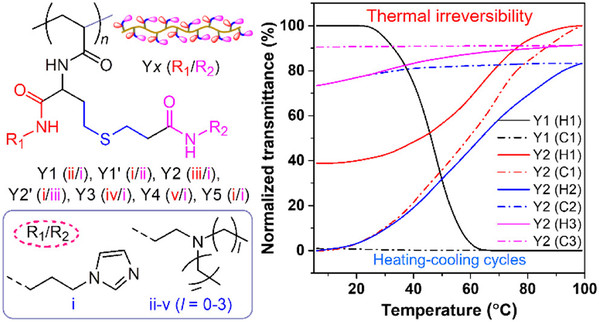
Abstract: Rational macromolecular design allows regulation of the phase transition and the degree of thermal reversibility. To elucidate the substituent effect, pH-sensitive dialkylamino and imidazolyl groups are incorporated into Y junction-bearing polymers (YJPs) to achieve thermoresponsive properties in continuous or discrete pH ranges. Owing to the intrinsic balances among hydrogen bonding, electrostatic, and hydrophobic interactions, variations in chemical composition, concentration, pH, and solvent isotope can lead to differences in thermoresponsivity. The increased size of the interior dialkylamino substituent tends to extend the pH ranges of thermoresponsivity, wherein dipropylamino/dibutylamino-containing YJPs can present alternating on–off lower critical solution temperature (LCST) behaviors between pH 3.0 and 11.0. YJP with an interior imidazolyl group and an exterior diethylamino group only exhibits LCST transition in H2O or D2O, while the sequence reversal of Y-substituents can lead to the consecutive formation of upper critical solution temperature (UCST), UCST-LCST, and LCST behaviors upon pH increment, revealing the influence of the location switch of heterosubstituents. With increasing heating–cooling cycles, YJP solutions tend to show one-off or several-off LCST/UCST behaviors due to distinct degrees of thermal memory of aggregation and dissociation. The progress of this study is beneficial for gaining insight into substituent-tunable thermal irreversibility, and various YJPs may hold great promise as functional materials with a distinct thermal memory effect.
Article information: https://doi.org/10.1021/acs.macromol.6c00281