
Piezocatalytic H2-Evolving Gradient-Porous Antibacterial Hydrogel Foam for Electrotherapy of Infected Pressure Ulcers
HeQingxiang1, YuanXiaonan1, RaoYu1, HengXingyu2, HuangShaopeng1, WangYuxuan1, JinCan1, SunZhe(孙哲)1*,GuoJiangna(郭江娜)1*, YanFeng(严锋)1,3*
1Jiangsu Engineering Laboratory of Novel Functional Polymeric Materials, Jiangsu Key Laboratory of Advanced Negative Carbon Technologies, Suzhou Key Laboratory of Soft Material and New Energy, College of Chemistry, Chemical Engineering and Materials Science, Soochow University, Suzhou, China
2School of Medicine, Nanjing University of Chinese Medicine, Nanjing, China
3State Key Laboratory of Advanced Fiber Materials, College of Materials Science and Engineering, Donghua University, Shanghai, China
Adv. Funct. Mater., 2026, 36, e31295
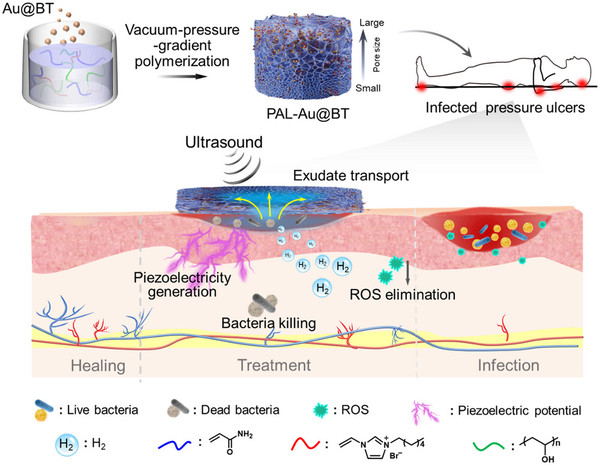
Abstract:Pressure ulcers (PUs) represent a critical global healthcare challenge. Sustained off-loading of tissue stress, microenvironmental regulation, and bacterial infection control are requirements for PU-preventive dressings. Herein, we engineer a multifunctional gradient porous piezoelectric hydrogel foam (PAL-Au@BT) integrating potent antibacterial activity, anti-inflammatory action, electrically stimulated pro-regenerative capacity, unidirectional exudate transport, and effective pressure dissipation to treat bacterial-infected PUs. Uniquely, PAL-Au@BT enables piezocatalytic generation of anti-inflammatory H2 and piezoelectric potential due to the encapsulated gold-coated BaTiO3 concurrently with ionic liquid-mediated antibacterial ability, there by achieving ROS scavenging, electrical stimulated cell proliferation, and bacterial eradication tri-modal therapeutic efficacy. Moreover, the architecturally engineered gradient pores of the PAL-Au@BT facilitate unidirectional fluid transport and dynamic pressure dissipation, actively optimizing the wound microenvironment. In vivo studies of infected PU models confirm that ultrasound-activated PAL-Au@BT significantly enhances bacterial elimination, suppresses inflammatory responses, and accelerates collagen deposition and angiogenesis to accelerate PUs healing. This work offers a new strategy for multifunctional piezoelectric dressing design by converging structural engineering, piezoelectric catalysis, and antibacterial therapeutics to address early-stage PUs pathophysiology.
Article information: https://doi.org/10.1002/adfm.202531295