
Dual-Response and Dual-Targeting Probe Based on the Quinolinothiazole Salt Capable of Decoding Cellular Stress and Cellular State
Hong-Di Xu, Qi Lin, Wen-Pei Ni, Jian-Feng Ge(葛健锋)*,Ru Sun(孙如)*
College of Chemistry, Chemical Engineering and Material Science, Soochow University, No. 199 Ren Ai Road, Suzhou 215123, China
Anal. Chem. 2026, 98, 12476–12483
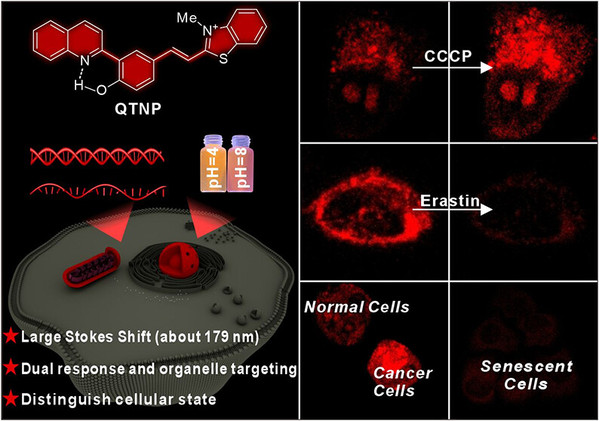
Abstract: The functional state of subcellular organelles served as a fundamental indicator of the cellular health. However, conventional fluorescent probes were largely limited to single-parameter detection, failing to capture coordinated interorganellar dynamics during pathological processes. Here, we developed a novel fluorescent probe, QTNP, based on a quinolinethiazolium scaffold. QTNP featured a large Stokes shift (~179 nm in Toluene) and dual-response capability, allowing simultaneous sensing of the local pH and nucleic acid activity. The limit of detections (LOD) toward DNA and RNA were calculated to be 1.43 μg/mL and 0.89 μg/mL, respectively, indicating the high sensitivity of QTNP. Furthermore, QTNP achieved dual targeting of mitochondria and nucleoli. Cell imaging displayed QTNP dynamically decoded cellular stress responses: it exhibited a 1.8-fold fluorescence enhancement in CCCP-induced mitochondrial dysfunction and showed significant, reversible quenching (6.0-fold decrease in total intensity) during Ferro ptosis, which was fully reversible upon the addition of Fer-1. Notably, based on its sensitive response to nucleic acid activity across different physiological states, QTNP reliably distinguished normal, cancerous, and senescent cells via baseline fluorescence intensity, showing 15 to 20-fold stronger signals in cancerous cells compared to normal cells. Therefore, this work provides a versatile tool for studying organelle interactions and cellular states in living systems.
Article information: https://doi.org/10.1021/acs.analchem.5c07794