
Interfacial Growth of Hexagonal Plate-like Cu-BTC on Polyacrylonitrile Fibers for the Construction of Cu-BTC/PAN Membranes
Lin Luo1,2, Yakun Tian3, Ming Dai3, Naijun Jiang3, Xueqin Cao1, Feifan Lang4, Jianping Lang1,2(郎建平)*,Hongwei Gu1(顾宏伟)*
1College of Chemistry, Chemical Engineering and Materials Science, Soochow University, Suzhou215123, Jiangsu,China
2State Key Laboratory of Organometallic Chemistry, Shanghai Institute of Organic Chemistry, Chinese Academy of Sciences, Shanghai 200032, China
3Jiangsu Sujing Group Co., Ltd., Suzhou 215122 Jiangsu, China
4Innovation Center for Chemical Science, College of Chemistry, Chemical Engineering and Materials Science, Soochow University, Suzhou 215123 Jiangsu, China
Inorg. Chem.2026, 65, 9750−9756
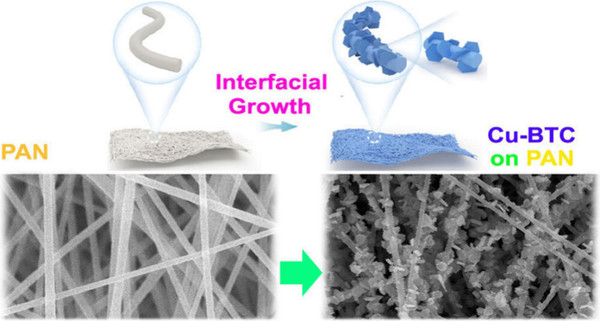
Abstract:Metal–organic frameworks (MOFs) have attracted extensive attention owing to their high surface areas, structural tunability, and broad applicability in separation, catalysis, and environmental remediation. Nevertheless, the practical utilization of MOFs remains hindered by their predominant powder form, which limits the processability and integration into macroscopic architectures. In this work, we report an interfacial synthesis strategy for the direct growth of hexagonal plate-like Cu-BTC crystals on polyacrylonitrile (PAN) fiber substrates, enabling the construction of a self-supported Cu-BTC/PAN membrane. The interfacial reaction conducted using copper acetylacetonate as the metal precursor under mild conditions (60 °C, 5 h) affords uniform MOF coverage and strong interfacial adhesion without additional binders or complex postfunctionalization steps. The resulting membrane exhibits a Cu-BTC loading of approximately 33% while maintaining structural integrity and flexibility. As a proof of concept, the Cu-BTC/PAN membrane demonstrates a CO2 adsorption capacity of 1.06 mmol g–1 at 1 bar and 25 °C. This interfacial synthesis approach offers a versatile pathway for integrating MOFs into fibrous membrane architecture and provides a general strategy for the scalable fabrication of MOF-based functional membranes.
Article information: https://doi.org/10.1021/acs.inorgchem.6c01265