
A small molecule donor containing a non-fused ring core for all-small-molecule organic solar cells with high efficiency over 11%
Xinxin Li a, Yan Wang a, Qinglian Zhu b, Xia Guo a, Wei Ma b, Xuemei Ou a, Maojie Zhang *a(张茂杰) and Yongfang Li ac
a Laboratory of Advanced Optoelectronic Materials, College of Chemistry, Chemical Engineering and Materials Science, Soochow University, Suzhou 215123, China.
b State Key Laboratory for Mechanical Behavior of Materials, Xi'an Jiaotong University, Xi'an 710049, China
c CAS Research/Education Center for Excellence in Molecular Sciences, CAS Key Laboratory of Organic Solids, Institute of Chemistry, Chinese Academy of Sciences, Beijing 100190, China
J. Mater. Chem. A, 2019, 7, 3682--3690
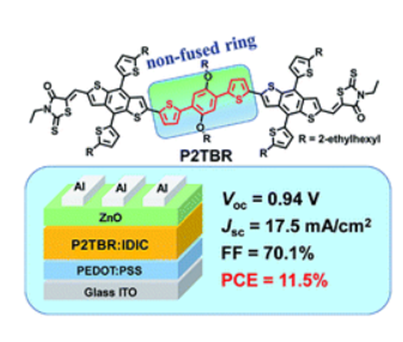
A novel p-type organic semiconductor (p-OS), P2TBR, based on a non-fused ring structure of thiophene–benzene–thiophene (TBT) as the core and 2D-conjugated benzodithiophene (BDT) units as π spacers and 3-ethylrhodanines as terminal groups, was synthesized and used as the donor material for all-small-molecule organic solar cells (SM-OSCs). P2TBR shows strong absorption, a low-lying HOMO energy level, high hole mobility and good thermal stability. The optimized P2TBR:IDIC film exhibits face-on and edge-on co-existent texture and three dimensional (3D) charge pathway, which is far better than the face-on orientated blend film without any treatment. As a result, a notable power conversion efficiency (PCE) of 11.5% and a satisfactory fill factor (FF) of 70.1% are achieved. This efficiency is the highest PCE for non-fullerene SM-OSCs reported in the literature so far. Overall, the results indicate that P2TBR is a promising candidate p-OS donor material for use in SM-OSCs, and the molecular design strategy for P2TBR provides the possibility that the simple-structured and easy to chemically modify non-fused unit can also be used as a building block in high performance p-OS donors.
链接:https://pubs.rsc.org/en/content/articlelanding/2019/ta/c8ta11441b#!divAbstract