
Coupling Molecularly Ultrathin Sheets of NiFe-Layered Double Hydroxide on NiCo2O4 Nanowire Arrays for Highly Efficient Overall Water-Splitting Activity
Zhiqiang Wang†, Sha Zeng‡, Weihong Liu†, Xingwang Wang†, Qingwen Li‡, Zhigang Zhao‡, and Fengxia Geng*†(耿凤霞)
† College of Chemistry, Chemical Engineering and Materials Science, Soochow University, Suzhou 215123, China
‡ Suzhou Institute of Nanotech and Nanobionics, Chinese Academy of Sciences, 398 Ruoshui Road, Suzhou Industry Park, Suzhou 215123, China
ACS Appl. Mater. Interfaces, 2017, 9 (2), pp 1488–1495
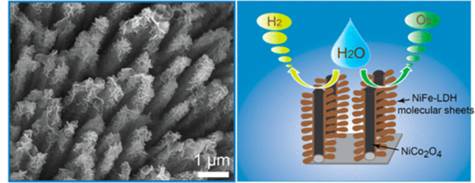
Developing efficient but nonprecious bifunctional electrocatalysts for overall water splitting in basic media has been the subject of intensive research focus with the increasing demand for clean and regenerated energy. Herein, we report on the synthesis of a novel hierarchical hybrid electrode, NiFe-layered double hydroxide molecularly ultrathin sheets grown on NiCo2O4 nanowire arrays assembled from thin platelets with nickel foam as the scaffold support, in which the catalytic metal sites are more accessible and active and most importantly strong chemical coupling exists at the interface, enabling superior catalytic power toward both oxygen evolution reaction (OER) and additionally hydrogen evolution reaction (HER) in the same alkaline KOH electrolyte. The behavior ranks top-class compared with documented non-noble HER and OER electrocatalysts and even comparable to state-of-the-art noble-metal electrocatalysts, Pt and RuO2. When fabricated as an integrated alkaline water electrolyzer, the designed electrode can deliver a current density of 10 mA cm–2 at a fairly low cell voltage of 1.60 V, promising the material as efficient bifunctional catalysts toward whole cell water splitting.
链接:http://pubs.acs.org/doi/abs/10.1021/acsami.6b13075