
Cadmium(II) Coordination Polymers of 4-Pyr-poly-2-ene and Carboxylates: Construction, Structure, and Photochemical Double [2 + 2] Cycloaddition and Luminescent Sensing of Nitroaromatics and Mercury(II) Ions
Wei-Jie Gong†, Zhi-Gang Ren†, Hong-Xi Li*†(李红喜), Jian-Guo Zhang†, and Jian-Ping Lang*†‡(郎建平)
† State and Local Joint Engineering Laboratory for Novel Functional Polymeric Materials, College of Chemistry, Chemical Engineering and Materials Science, Soochow University, Suzhou 215123, Jiangsu, People’s Republic of China
‡ State Key Laboratory of Organometallic Chemistry, Shanghai Institute of Organic Chemistry, Chinese Academy of Sciences, Shanghai 200032, People’s Republic of China
Cryst. Growth Des., 2017, 17 (2), pp 870–881
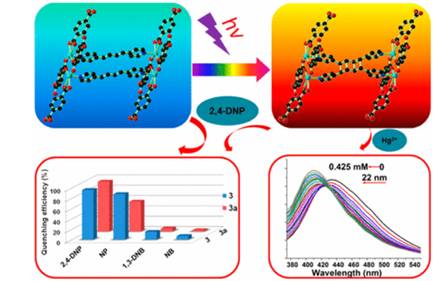
Solvothermal reactions of Cd(NO3)2·4H2O with 4-pyr-poly-2-ene (ppene) in the presence of benzene-1,2-dicarboxylic acid (1,2-H2BDC), benzene-1,3-dicarboxylic acid (1,3-H2BDC), benzene-1,4-dicarboxylic acid (1,4-H2BDC), benzene-1,3,5-tricarboxylic acid (1,3,5-H3BTC), or 4,4′-oxidibenzoic acid (4,4′-H2OBA) afforded five Cd(II) coordination polymers [Cd(ppene)(1,2-BDC)]n (1), [Cd(ppene)(1,3-BDC)]n (2), [{Cd(ppene)(1,4-BDC)}·MeCN]n (3) (Liu et al. Inorg. Chem. Commun. 2015, 58, 1−4), [{Cd(ppene)(1,3,5-HBTC)}·0.5(ppene)]n (4), and [Cd(ppene)(4,4′-OBA)]n (5), respectively. Upon UV light irradiation, 1, 3, and 4 can undergo a double [2 + 2] cycloaddition reaction to yield their corresponding photoproducts including [Cd2(4-tp-3-lad)(1,2-BDC)2]n (1a, 4-tp-3-lad = 2,3,5,6-tetra(pyridin-4-yl)bicyclo[2.2.0]hexane), [{Cd2(4-tp-3-lad)(1,4-BDC)2}·2MeCN]n (3a), and [{Cd2(4-tp-3-lad)(1,3,5-HBTC)2}·(ppene)]n (4a) in a single-crystal-to-single-crystal manner. Compounds 1, 2, 4, 5, 1a, 3a, and 4a have been structurally characterized by elemental analysis, infrared spectroscopy, powder X-ray diffraction, and single-crystal X-ray diffraction. Compounds 1, 1a, 4 and 4a consist of two-dimensional (2D) (4,4) networks, in which one-dimensional (1D) [Cd2(1,2-BDC)2]n or [Cd2(1,3,5-HBTC)2]n chains are linked by ppene or 4-tp-3-lad bridges. 2 has a three-dimensional (3D) 3-fold interpenetrated framework formed from bridging 1D [Cd2(1,3-BDC)2]n double chains by ppene ligands. Compounds 3a and 5 contain 3D frameworks assembled by linking 2D [Cd2(1,4-BDC)2]n or [Cd2(4,4′-OBA)2]n networks by 4-tp-3-lad or ppene bridges. In the three photoreactions, each ppene ligand had its two conjugated C═C bonds parallel to those of the neighboring ppene. The resulting ppene pair was transformed into the only product, 4-tp-3-lad, through a unique double [2 + 2] cycloaddition. Photoluminescence properties of these compounds in water were also investigated. Compound 3a as a representative example was proven to be an efficient probe for dual detections of nitroaromatics and Hg2+ in aqueous solutions.
链接:http://pubs.acs.org/doi/abs/10.1021/acs.cgd.6b01728