
Robust, Responsive, and Targeted PLGA Anticancer Nanomedicines by Combination of Reductively Cleavable Surfactant and Covalent Hyaluronic Acid Coating
Jintian Wu, Jian Zhang, Chao Deng*(邓超), Fenghua Meng, Ru Cheng, and Zhiyuan Zhong*(钟志远)
Biomedical Polymers Laboratory, College of Chemistry, Chemical Engineering and Materials Science, Soochow University, Suzhou 215123, People’s Republic of China
ACS Appl. Mater. Interfaces, 2017, 9 (4), pp 3985–3994
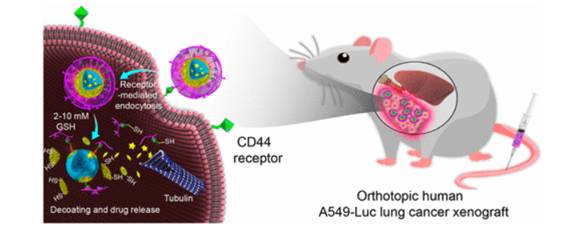
PLGA-based nanomedicines have enormous potential for targeted cancer therapy. To boost their stability, targetability, and intracellular drug release, here we developed novel multifunctional PLGA anticancer nanomedicines by combining a reductively cleavable surfactant (RCS), vitamin E–SS–oligo(methyl diglycol l-glutamate), with covalent hyaluronic acid (HA) coating. Reduction-sensitive HA-coated PLGA nanoparticles (rHPNPs) were obtained with small sizes of 55–61 nm and ζ potentials of −26.7 to −28.8 mV at 18.4–40.3 wt % RSC. rHPNPs were stable against dilution and 10% FBS while destabilized under reductive condition. The release studies revealed significantly accelerated docetaxel (DTX) release in the presence of 10 mM glutathione. DTX–rHPNPs exhibited potent and specific antitumor effect to CD44 + A549 lung cancer cells (IC50 = 0.52 μg DTX equiv/mL). The in vivo studies demonstrated that DTX–rHPNPs had an extended circulation time and greatly enhanced tolerance in mice. Strikingly, DTX–rHPNPs completely inhibited growth of orthotopic human A549-Luc lung tumor in mice, leading to a significantly improved survival rate and reduced adverse effect as compared to free DTX. This study highlights that advanced nanomedicines can be rationally designed by combining functional surfactants and surface coating.
链接:http://pubs.acs.org/doi/abs/10.1021/acsami.6b15105