
Fluorescence Development of Latent Fingerprint with Conjugated Polymer Nanoparticles in Aqueous Colloidal Solution
Hong Chen†#, Rong-liang Ma*‡#, Yun Chen†, and Li-Juan Fan*†(范丽娟)
† State and Local Joint Engineering Laboratory for Novel Functional Polymeric Materials, Jiangsu Key Laboratory of Advanced Functional Polymer Design and Application, Department of Polymer Science and Engineering, College of Chemistry, Chemical Engineering and Materials Science, Soochow University, Suzhou, Jiangsu 215123, P. R. China
‡ Institute of Forensic Science, Ministry of Public Security, Beijing 100038, P. R. China
ACS Appl. Mater. Interfaces, 2017, 9 (5), pp 4908–4915
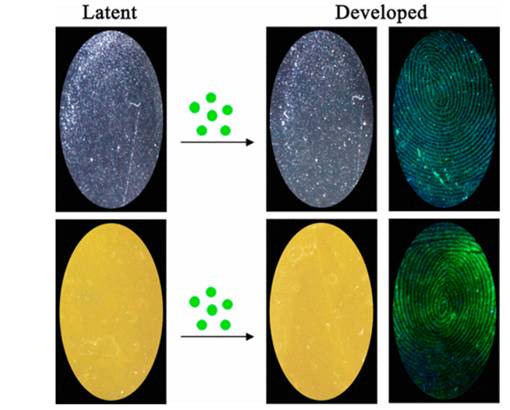
Poly(p-phenylenevinylene) (PPV) nanoparticles in aqueous colloidal solution have been prepared via a modified Wessling method, with the addition of surfactant. The fluorescent colloidal solution was used as the developing solution to develop the fingerprints on different substrates. The developing process was accomplished simply by immersing the substrates into developing solution and then taking out, followed by rinsing with deionized water. The initial study about the fingerprints on the adhesive tapes showed that the developing solution is very effective in fluorescence development on both fresh and aged visible fingerprints; and such an effect was negligibly affected by treating the fingerprints with water or other organic solvents, whether before developing or after. Further study on latent fingerprints (LFPs) demonstrated that PPV nanoparticles in colloidal solution have high sensitivity in developing fingerprints to give very clearly fluorescent patterns. At least 6 months of storage of the colloidal solution did not reduce the developing effect; and each developing solution (3.6 mg/mL, 5.0 mL) can be used to develop at least 30 fingerprints without sacrificing the legibility of the pattern. The preliminary mechanism investigation suggested that selectivity achieved toward the ridge of the fingerprint is very likely due to the affinity between PPV molecules and oily secretions of the fingerprints. Digital magnification of the developed fingerprints provided more details about the fingerprint.
链接:http://pubs.acs.org/doi/abs/10.1021/acsami.6b15951