
3D–2D heterostructure of PdRu/NiZn oxyphosphides with improved durability for electrocatalytic methanol and ethanol oxidation
Hui Xu, Pingping Song, Yangping Zhang and Yukou Du *(杜玉扣)
College of Chemistry, Chemical Engineering and Materials Science, Soochow University, Suzhou 215123, PR China.
Nanoscale, 2018, 10, 12605--12611
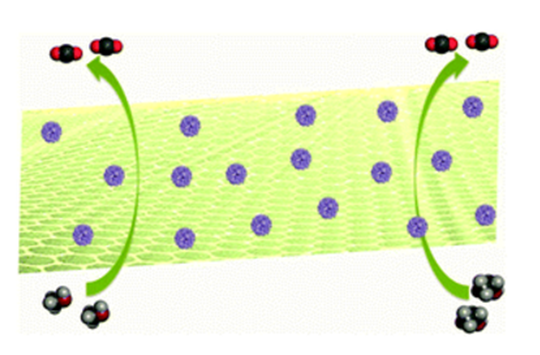
The rational design and engineering of bimetallic Pd-based nanocatalysts with both high activity and durability are of paramount significance for the practical applications of fuel cells. Herein, a new class of well-defined 2D NiZn oxyphosphide nanosheets (NiZnP NSs) have been successfully engineered to support unique 3D PdRu nanoflowers (PdRu NFs)viaa facile strategy. Such nanohybrids with abundant surface active areas and modified electronic structure exhibit a great enhancement in electrocatalytic activity for the methanol oxidation reaction (MOR) and ethanol oxidation reaction (EOR), whose mass/specific activities are 1739.5 mA mg−1/4.5 mA cm−2and 4719.8 mA mg−1/12.3 mA cm−2, which are 8.3/9.0 and 8.3/9.5 times higher than those of commercial Pd/C catalysts, respectively. More interestingly, with the remarkable promotional effect of NiZnP NSs, such 3D–2D PdRu/NiZn oxyphosphide nanohybrids can even retain 72.4% and 70.1% of initial catalytic activity toward MOR and EOR for 1000 potential cycles with negligible morphological or compositional variations. The successful construction of this new class of electrocatalysts opens up a new way for designing 3D–2D nanohybrids with high performance for electrochemical reactions and beyond.
链接:http://pubs.rsc.org/en/Content/ArticleLanding/2018/NR/C8NR03386B#!divAbstract