
Improving Photoluminescence Emission Efficiency of Nanocluster-Based Materials by in Situ Doping Synthetic Strategy
Jian Lin†, Dan-Dan Hu†, Qian Zhang†, Dong-Sheng Li‡, Tao Wu*†(吴涛), Xianhui Bu§, and Pingyun Feng*∥
† College of Chemistry, Chemical Engineering and Materials Science, Soochow University, Jiangsu 215123, China
‡ College of Materials and Chemical Engineering, Hubei Provincial Collaborative Innovation Center for New Energy Microgrid, Key Laboratory of Inorganic Nonmetallic Crystalline and Energy Conversion Materials, China Three Gorges University, Yichang 443002, China
§ Department of Chemistry and Biochemistry, California State University Long Beach, 1250 Bellflower Boulevard, Long Beach, California 90840, United States
∥ Department of Chemistry, University of California, Riverside, California 92521, United States
J. Phys. Chem. C, 2016, 120 (51), pp 29390–29396
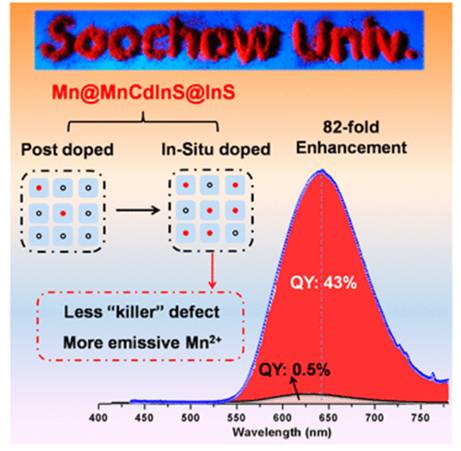
Solid-state red phosphors of Mn2+-doped nanocrystals usually suffer from poor intensity. While the d–d emission of Mn2+ in yellow window has been extensively studied, shift toward lower energy remains challenging. Typically, intrinsic surface defects and self-purification of dopants are two obstacles for enhancing the intensity of red emission. Moreover, for red phosphors Mn2+ ions also need an appropriate host matrix and environment. Through an in situ doping strategy and optimization of the Mn2+ doping level, intense red-emitting Mn2+ dopant emission is reported here for MnCdInS@InS host. The doping strategy allows doping of Mn2+ at the core and/or surface sites of supertetrahedral “core–shell” nanocluster (Mn@MnCdInS@InS), leading to the red emission (at 643 nm) with over 40% quantum yield. Moreover, systematic control of doping level results in a series of crystalline Mn2+-doped materials with tunable photoluminescence quantum yield. In addition to the synthesis of an important class of red-emitting materials rarely obtained from Mn2+ doping, details of the physical chemistry associated with the doping process are probed with the new fundamental findings reported here.
链接:http://pubs.acs.org/doi/abs/10.1021/acs.jpcc.6b09126