
Facile fabrication of heterostructured cubic-CuFe2O4/ZnO nanofibers (c-CFZs) with enhanced visible-light photocatalytic activity and magnetic separation
Chuchu Lu a, Zhimin Bao a, Chuanxiang Qin*a(秦传香), Lixing Daia and Aiping Zhub
a College of Chemistry, Chemical Engineering and Materials Science, Soochow University, Suzhou, People's Republic of China
b College of Chemistry and Chemical Engineering, Yangzhou University, Yangzhou, People's Republic of China
RSC Adv., 2016,6, 110155-110163
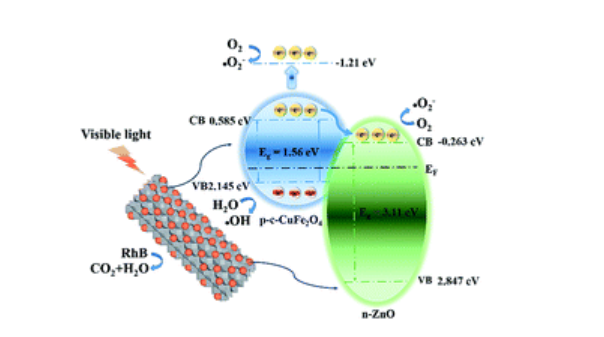
A novel p–n heterojunction photocatalyst of cubic-CuFe2O4/ZnO nanofibers (c-CFZs) was fabricated through a simple and economical technique of electrospinning technique combined with coprecipitation method. The products were characterized by X-ray diffraction (XRD), scanning electron microscopy (SEM), transmission electron microscopy (TEM), and vibrating sample magnetometer (VSM). The prepared cubic-CuFe2O4 (c-CuFe2O4) nanofibers revealed lengths of several micrometers and were composed of many c-CuFe2O4 nanoparticles about 15–20 nm in size. After coprecipitation, the surface of c-CuFe2O4 nanofibers was densely covered with ZnO particles. The photocatalytic activity was evaluated by monitoring the degradation of the dye model Rhodamine B (RhB) under visible-light irradiation. Compared with pure ZnO and c-CuFe2O4, the c-CFZs exhibited a better photocatalytic performance. The enhanced activity could be attributed to the extended absorption in the visible light region resulting from c-CuFe2O4 and the effective separation of photo-generated carriers driven by the photo-induced potential difference generated at the p–n heterojunction photocatalyst of c-CFZs. Furthermore, these nanofibers could be recollected easily with a magnet after the photocatalytic process, avoiding secondary pollution of treated water effectively.
链接:http://pubs.rsc.org/is/content/articlelanding/2016/ra/c6ra23970f#!divAbstract