
Confinement Effects of Metal–Organic Framework on the Formation of Charge-Transfer Tetrathiafulvalene Dimers
Ting Chen, Peng Huo, Jin-Le Hou, Jing Xu, Qin-Yu Zhu*(朱琴玉), and Jie Dai*(戴洁)
College of Chemistry, Chemical Engineering and Materials Science, Soochow University, Suzhou 215123, P. R. China
Inorg. Chem., 2016, 55 (24), pp 12758–12765
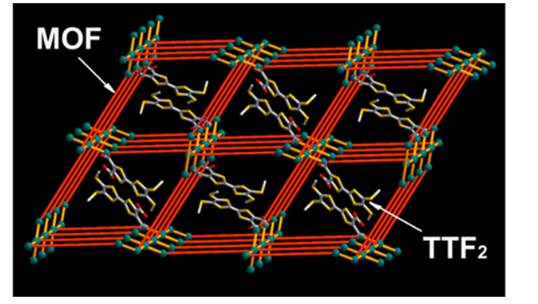
Three transition metal coordination polymers (CPs) based on the redox-active dimethylthio-tetrathiafulvalene-bicarboxylate (L) and 1,3-bi(4-pyridyl)propane (bpp) ligands, formulated as [MnL(bpp)]n (1), [CdL(bpp)]n (2), and [Cd2L(bpp)2(H2O)(C2O4)0.5]n·n(ClO4)·n(H2O) (3), are crystallographically characterized. Complexes 1 and 2 are isostructural 2-D polymers, and 3 features an unusual 3-D metal–organic framework (MOF). The 3-D MOF is constructed from tetranuclear cluster nodes built through the μ2-O bridge of the TTF ligand, which is first found for TTF coordination polymers. It is found that the channel generated by the 3-D MOF exerts a confinement effect on the formation of TTF dimers. The TTF dimers show strong intradimer interaction with partial electron transfer or charge transfer, and hence, the Cd compound 3 has relatively good photocurrent response property in comparison with that of 2-D Cd compound 2.
链接:http://pubs.acs.org/doi/abs/10.1021/acs.inorgchem.6b02062