
Origin of Increasing Dielectric Constant at Lower Percolation Threshold through Controlling Spatial Distribution of Carbon Nanotubes in Epoxy Resin with Microwave-Assisted Thermal Curing Technique
Chuan Liu, Longhui Zheng, Li Yuan, Qingbao Guan, Aijuan Gu*(顾嫒娟), and Guozheng Liang*(梁国正)
State and Local Joint Engineering Laboratory for Novel Functional Polymeric Materials, Jiangsu Key Laboratory of Advanced Functional Polymer Design and Application, Department of Materials Science and Engineering, College of Chemistry, Chemical Engineering and Materials Science, Soochow University, Suzhou, 215123, China
J. Phys. Chem. C, 2016, 120 (50), pp 28875–28885
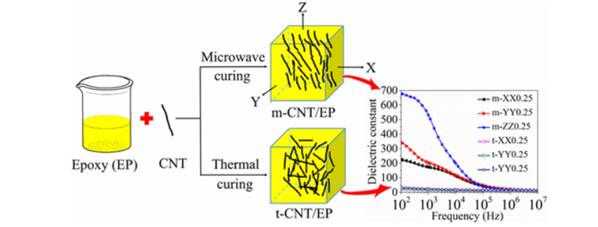
How to fabricate polymer composites with higher dielectric constant at lower content of conductors based on commercial compositions is still an interesting topic with great challenge. Herein, based on multiwalled carbon nanotubes (CNTs) and epoxy resin (EP), new high dielectric constant (high-k) composite (m-CNT/EP) with much higher permittivity and lower percolation threshold (fc) was prepared by a microwave-assisted thermal curing technology. Results show that the spatial structure and performances of CNT/EP composites are dependent on the curing process used. CNTs are orientated along the Z direction in m-CNT/EP composites, while they are randomly permutated in the composite (t-CNT/EP) produced with a traditional thermal curing procedure. Accordingly, t-CNT/EP composites have isotropic dielectric properties, and m-CNT/EP composites exhibit anisotropic dielectric properties. fc values of m-CNT/EP composites in the X, Y, and Z directions are 0.29, 0.29, and 0.24 wt %, respectively, while those of t-CNT/EP composites are equal to 0.39 wt %. When the loading of CNTs is 0.25 wt %, the dielectric constant in the Z direction of m-CNT0.25/EP is as high as 673, about 20.7 times of that of t-CNT0.25/EP. The origin behind these interesting results is discussed from building the relationship between CNT distribution and dielectric properties using finite elements and simulating equal circuits.
链接:http://pubs.acs.org/doi/abs/10.1021/acs.jpcc.6b10567