
Haifeng Zhang Rui Liu Jin Zhang Yahong LiWei Liu
a College of Chemistry, Chemical Engineering and Materials Science, Soochow University, Suzhou 215123, China
b Department of Chemistry and Chemical Engineering, Jining University, Qufu 273155, China
CrystEngComm, 2016,18, 8246-8252
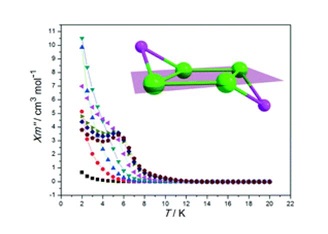
The employment of a Schiff base ligand 2-((2-(hydroxymethyl)phenylimino)methyl)phenol (H2L) in the synthesis of LnIII–CoIII clusters is reported. Four isomorphous hexanuclear clusters of compositions [Ln4Co2(μ3-OH)2(NO3)4(CH3COO)4L4(DMF)2]·2C2H5OH [H2L = 2-((2-(hydroxymethyl)phenylimino)methyl)-6-methoxyphenol; Ln = Dy (1), Eu (2), Gd (3), Tb (4)] have been prepared under solvothermal conditions. The centrosymmetric hexanuclear metallic core is composed of a defect-dicubane Ln4 moiety and two CoIII ions which are linked to the defect-dicubane unit through two alkoxo groups and two phenoxido groups. This structure gives a chair-like topology. The magnetic properties of 1–4 were studied. The Dy4 unit of 1 exhibits slow magnetic relaxation behavior. The Ueff for 1 of 41.9 K is a relatively high value among those reported for Dy4 SMMs with defect-dicubane cores. This value is also much higher than those reported for [DyIII4CoIII2] SMMs. This work further illustrates that hydroxide-containing Schiff bases are very effective ligands for designing 3d–4f-based SMMs.
链接:http://pubs.rsc.org/en/content/articlelanding/2016/ce/c6ce01589a#!divAbstract