
Fengyang Xu†Jie Liu†Jian Tian‡Linfeng Gao†Xiaju Cheng‡Yue Pan†Ziling Sun*‡(孙自玲)Xinming Li*†⊥
† State and Local Joint Engineering Laboratory for Novel Functional Polymeric Materials, College of Chemistry, Chemical Engineering and Materials Science, Soochow University, Suzhou 215123, China
‡ School of Biology and Basic Medical Science, Soochow University, Suzhou 215123, China
⊥ State Key Laboratory of Molecular Engineering of Polymers, Fudan University, Shanghai 200433, China
ACS Appl. Mater. Interfaces, 2016, 8 (44), pp 29906–29914
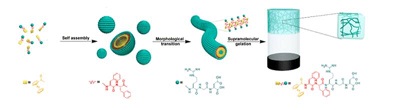
In this work, we reported the generation of a novel supramolecular hydrogelator from a peptide derivative which consisted of a structural motif (e.g., Fc-FF) for supramolecular self-assembly and a functional moiety (e.g., RGD) for integrin binding. Following self-assembly in water at neutral pH, this molecule first tended to form metastable spherical aggregates, which subsequently underwent a morphological transformation to form high-aspect-ratio nanostructures over 2 h when aged at room temperature. More importantly, because of the presence of nanoscale RGD clusters on the surface of nanostructures, the self-assembled nanomaterials (e.g., nanoparticles and nanofibers) can be potentially used as a biomimetic matrix for cell culture and as a vector for cell-targeting drug delivery via multivalent RGD–integrin interactions.
链接:http://pubs.acs.org/doi/abs/10.1021/acsami.6b08624