
a College of Chemistry, Chemical Engineering and Materials Science, Soochow University, Jiangsu 215123, China
b The Key Laboratory of the Materials for Energy Storage and Conversion of Shanxi Province, Institute of Molecular Science, Shanxi University, Taiyuan 030006, China
c College of Materials and Chemical Engineering, Key Laboratory of Inorganic Non-metallic Crystalline and Energy Conversion Materials, China Three Gorges University, Yichang 443002, China
d School for Radiological and Interdisciplinary Sciences (RAD-X), Soochow University, Jiangsu 215123, China
e State Key Laboratory of Inorganic Synthesis and Preparative Chemistry, International Joint Research Laboratory of Nano-Micro Architecture Chemistry, College of Chemistry, Jilin University, Changchun 130012, P. R. China
J. Mater. Chem. C, 2016,4, 10435-10444
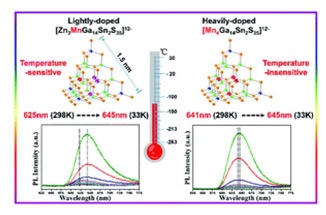
Mn2+-Doped semiconductor nanocrystals or quantum dots have been extensively studied as potential yellow/orange/red phosphors due to the stable Mn2+-related emission tuned by its tetrahedral coordination environment in host lattices. However, it is still very difficult to objectively explore the location–performance relationship in conventional Mn2+-doped nanomaterials since the precise location information on Mn2+ dopants is generally unavailable due to their random distribution in host lattices. Herein, we purposely selected a specific supertetrahedral-nanocluster-based molecular crystal (OCF-40-ZnGaSnS, composed of isolated supertetrahedral T4-ZnGaSnS nanoclusters (NCs) with the formula [Zn4Ga14Sn2S35]12−) as a host lattice, and effectively controlled the relatively precise position of Mn2+ dopants in host lattices of T4-ZnGaSnS NCs by in situ substitution of Zn2+ sites by Mn2+ ions, and investigated the Mn2+-location-dependent red emission properties. The current study clearly indicates that a long-lifetime (∼170 μs) red emission centred at 625 nm at room temperature for lightly-doped [Zn3MnGa14Sn2S35]12− NCs with one Mn2+ dopant in its surface centre is very sensitive to temperature and dramatically red-shifts to 645 nm at 33 K upon the excitation of 474 nm. However, heavily-doped OCF-40-MnGaSnS (composed of T4-MnGaSnS NCs with the formula [Mn4Ga14Sn2S35]12−, in which four Mn2+ dopants are accurately located at its core in the form of Mn4S) gives the temperature-insensitive red emission with a longer wavelength (641 nm) and a shorter lifetime (42 μs) at room temperature. This phenomenon is pretty uncommon compared to other heavily Mn2+-doped semiconductors. Such differences in their PL properties are ascribed to Mn2+-location-induced lattice strain to different degrees in two Mn2+-doped supertetrahedral NCs. In addition, the Mn2+-related red emission of both samples can be predominantly induced by the direct excitation of Mn2+ ions and secondarily by indirect excitation through exciton energy transfer from host lattices to Mn2+ dopants. Consistently, the DFT calculations suggest that the emission of NCs originated from the transition from the low spin excited state of Mn2+ (4T1) to its high spin ground state (6A1). The calculation results also revealed that the emission wavelength of lightly-doped [Zn3MnGa14Sn2S35]12− NCs is not obviously affected by the temperature-induced thermal effect, but by temperature-induced structural contraction, while that of heavily-doped [Mn4Ga14Sn2S35]12− NCs is affected by both effects. The total temperature cooling effect on the emission of [Zn3MnGa14Sn2S35]12− NCs is the red-shift, while that on the emission of [Mn4Ga14Sn2S35]12− NCs is negligible, which is akin to the experimental results. This research opens up a new perspective and provides a feasible method to explore the location–performance relationship of other Mn2+-doped NCs.
链接:http://pubs.rsc.org/en/Content/ArticleLanding/2016/TC/C6TC03844A#!divAbstract