
a Laboratory of Advanced Optoelectronic Materials, College of Chemistry, Chemical Engineering and Materials Science, Soochow University, Suzhou 215123, China
b Beijing National Laboratory for Molecular Sciences, CAS Key Laboratory of Organic Solids, Institute of Chemistry, Chinese Academy of Sciences, Beijing 100190, China
c University of Chinese Academy of Sciences, Beijing 100049, China
J. Mater. Chem. A, 2016,4, 14752-14760
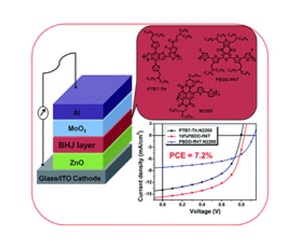
Ternary blending is one of the effective strategies to broaden the complementary absorption range and smooth the energy level at the donor/acceptor interface for achieving high efficiency bulk heterojunction (BHJ) polymer solar cells (PSCs). In this study, we report efficient ternary blend all-polymer solar cells (all-PSCs) with complementary absorption bands based on two polymer donors PTB7-Th and PBDD-ff4T and one polymer acceptor N2200. The polythiophene derivative PBDD-ff4T as a hole-cascade material plays a bridging role in energy levels between PTB7-Th and N2200, and thus provides more efficient channels for charge transfer. The ternary all-PSCs with 10 wt% PBDD-ff4T content show efficient photon harvesting, enhanced charge mobility and better active layer morphology due to the induced crystallization of PTB7-Th by the inserted PBDD-ff4T in the donor domains. As a result, the device without any extra treatments exhibits an optimized power conversion efficiency (PCE) of 7.2% with an open circuit voltage (Voc) of 0.82 V, a short circuit current density (Jsc) of 15.7 mA cm−2, and a fill factor (FF) of 56%. While the PCEs are 5.9% and 4.2% for the all-PSCs based on the binary blends PTB7-Th:N2200 and PBDD-ff4T:N2200, respectively. This PCE of 7.2% is one of the highest values reported in the literature so far for ternary all-PSCs and polythiophene derivative-based all-PSCs.
链接:http://pubs.rsc.org/en/content/articlelanding/2016/ta/c6ta05932e#!divAbstract