
a College of Chemistry, Chemical Engineering and Materials Science, Soochow University, Suzhou 215123, China
b Key Laboratory of Salt Lake Resources and Chemistry, Qinghai Institute of Salt Lakes, Chinese Academy of Sciences, Xining 810008, P. R. China
Dalton Trans., 2016,45, 16463-16470
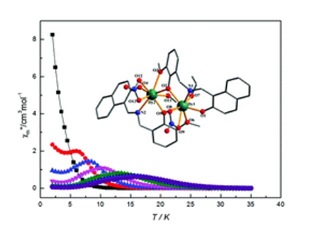
The employment of a new Schiff base ligand, 2-{[(2-hydroxy-3-methoxybenzyl)imino]methyl}naphthalen-1-ol (H2L), in 4f-metal chemistry has led to the formation of seven new isostructural lanthanide(III) complexes. More specifically the 1:1 reaction of Ln(NO3)3·6H2O and H2L in ethanol in the presence of 3 equivalents of pyridine yielded seven dinuclear complexes of compositions [Ln2L2(NO3)2(C2H5OH)2]·0.5py (Ln = Eu (1), Gd (2), Tb (3), Dy (4), Ho (5), Er (6), Yb (7); py = pyridine). The structures of the isomorphous complexes 1–7 were determined by single-crystal X-ray crystallography. X-ray crystallography data reveal that each compound is neutral, and contains two doubly-deprotonated ligands, two chelated nitrates and two coordinated ethanol molecules. The two LnIII atoms in 1–7 are doubly bridged by the two phenolato oxygen atoms of two L2− ligands. Each of the two lanthanide ions is eight-coordinated and possesses distorted dodecahedron geometry. Dc magnetic susceptibility studies in the 2–300 K range reveal probably a weak antiferromagnetic interaction for 2, 3 and 6, and a ferromagnetic interaction at low temperature for 4 and 5. Complexes 4 and 5 show slow magnetic relaxation behavior. The Ueff for 4 of 66.7 K is a relatively high value among the reported Dy2 SMMs. Complex 5 is a very rare example of a Ho2 compound which exhibits slow magnetic relaxation.
链接:http://pubs.rsc.org/en/Content/ArticleLanding/2016/DT/C6DT02962K#!divAbstract