
Zongkuan Yuea, Aijun Liua Chunyong Zhanga, Jie Huanga, b, Mingshan Zhuc, * , Yukou Dua, Ping Yanga, * (杨平)
a College of Chemistry, Chemical Engineering and Materials Science, Soochow University, Suzhou 215123, China
b Key Laboratory of Nano-Bio Interface, Division of Nanobiomedicine, Suzhou Institute of Nano-Tech and Nano-Bionics, Chinese Academy of Sciences, Suzhou 215123, China
c The Institute of Scientific and Industrial Research (SANKEN), Osaka University, Osaka 567-0047, Japan
Applied Catalysis B: Environmental ,Volume 201, February 2017, Pages 202–210
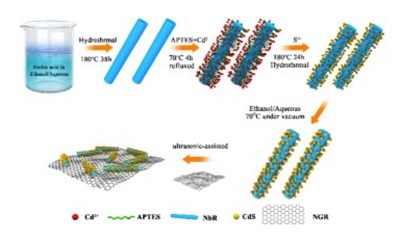
In this paper, visible-light-driven photocatalysts composed of CdS nanoparticles, Nb2O5 nanorods (NbR) and N-doped graphene (NGR) nanosheets for photocatalytic water reduction to produce hydrogen have been synthesized. Under visible light irradiation, the prepared ternary nanocomposites showed distinctly enhanced photocatalytic performance for hydrogen evolution compared to bare CdS, NbR and CdS/Nb2O5. The sample with 2 wt.% NGR exhibited the highest photocatalytic activity, which is ca. 7.7 times as high as that evolved from CdS. The enhancement of photocatalytic performance may be related to the unique one dimension (1D) Nb2O5 structure with high surface-to-volume ratio, which can provide intimate interfacial contact between NbR and CdS nanoparticles, as well as the CdS/Nb2O5 heterojunction structure and two dimension (2D) NGR, which enhance the separation efficiency of photogenerated charge carriers. This work provides a promising and cost-effective method by combining the 0D CdS nanoparticles, 1D Nb2O5 nanorods and 2D N-doped graphene to form a ternary photocatalytic system for highly efficient hydrogen evolution from water without using any noble metals.
链接:http://www.sciencedirect.com/science/article/pii/S0926337316306361