
Pan Gao, Hui Cao, Yi Ding, Meng Cai, Zhigang Cui, Xinhua Lu, and Yuanli Cai*(蔡远利)
State-Local Joint Engineering Laboratory of Novel Functional Polymeric Materials, Jiangsu Key Laboratory of Advanced Functional Polymer Design and Application, Suzhou Key Laboratory of Macromolecular Design and Precision Synthesis, College of Chemistry, Chemical Engineering and Materials Science, Soochow University, Suzhou 215123, China
ACS Macro Lett. 2016, 5, 1327−1331
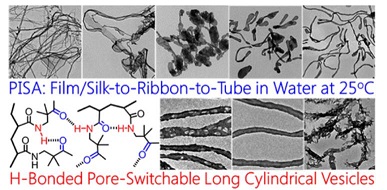
Analogous to cellulose, polymers whose monomer units possess both hydrogen donators and acceptors are generally insoluble in ambient water because of hydrogen bonding (HB). Herein we present stimuli-responsive long aqueous cylindrical vesicles (nanotubes) synthesized directly using HB-driven polymerization-induced self-assembly (PISA) under visible-light-mediated RAFT aqueous dispersion polymerization at 25 °C. The PISA undergoes an unprecedented film/silk-to-ribbon-to-vesicle transition and films/silks/ribbons formed at low DPs (∼25–85) of core-forming block in free-flowing aqueous solution. Pore-switchable nanotubes are synthesized by electrostatic repulsive perturbation of the HB association in anisotropic vesicular membranes via inserting minor ionized monomer units into the core-forming block. These nanotubes are synthesized at >35% solids, and tubular membranes are more sensitive than spherical counterparts in response to aqueous surroundings. This facile, robust, and general strategy paves a new avenue toward scale-up production of advanced intelligent nanomaterials.
链接:http://pubs.acs.org/doi/full/10.1021/acsmacrolett.6b00796