
Tiantian Dong, Liuyi Hu, Kang Zhao, Anping Deng*(邓安平), Jianguo Li*(李建国)
The Key Lab of Health Chemistry & Molecular Diagnosis of Suzhou, College of Chemistry, Chemical Engineering & Materials Science, Soochow University,Suzhou 215123, China
Analytica Chimica Acta 945 (2016) 85-94
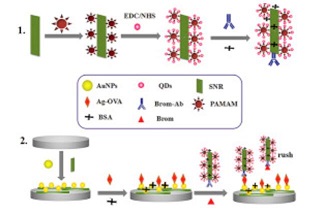
Electrochemiluminescent (ECL) immunosensor with multiple signal amplification was designed based on gold nanoparticles (AuNPs), polyamidoamine dendrimers (PAMAM) and silver-cysteine hybrid nanoribbon (SNR). Low toxic l-cysteine capped CdSe QDs was chosen as the ECL signal probe. To verify the proposed ultrasensitive ECL immunosensor for β-adrenergic agonists (β-AA), we detected Brombuterol (Brom) as a proof-of-principle analyte. Therein, AuNPs as the substrate can simplify the experiment process, accelerate the electron transfer rate, and carry more coating antigen (Ag-OVA) to enlarge ECL signal. On one hand, SNR on the surface of electrode can avoid the aggregation of AuNPs, and SNR-PAMAM-AuNPs also can be acted as a good accelerator for electron transfer. On the other hand, PAMAM (16 -NH2) functionalized SNR (SNR-PAMAM) with numerous amino groups could be employed to bond abundant actived QDs to further amplify ECL signal. The new immunosensor can offer a simple, reliable, rapid, and selective detection for Brom, which have a dynamic range of 0.005–700 ng mL−1 with a low detection limit at 1.5 pg mL−1. The proposed biosensor will extend the application of nanomaterials in ECL immunoassays and open a new road for the detection of Brom and other β-AA in the future.
链接:http://www.sciencedirect.com/science/article/pii/S0003267016311898