
Yang Liu1,2 , Qi Wang2 , Pei She1 , Jin Gong2 , Weiping Wu2 , Shouming Xu1 ,Jianguo Li1,* (李建国),Kang Zhao1 , Anping Deng1,*(邓安平)
1 The Key Lab of Health Chemistry & Molecular Diagnosis of Soochow, College of Chemistry, Chemical Engineering & Materials Science, Soochow University, Soochow 215123, China
2 School of Public Health, Nantong University, Nantong 226019,
Peoples Republic of China
Microchim Acta (2016) 183:2847–2854
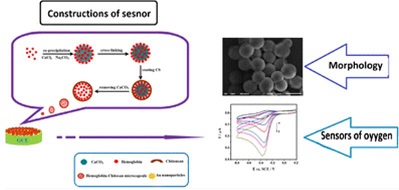
The article describes the preparation of chitosan-coated hemoglobin (Hb-CS) microcapsules by (a) preparing a CaCO3 precipitate containing Hb, (b) crosslinking Hb with glutaraldehye, (c) coating the particles with chitosan, and (d) preparing Hb-CS microcapsules by removing the CaCO3 template with a solution of disodium EDTA. The morphology and electrochemical properties of the Hb-CS microcapsules were investigated by scanning electron microscopy, cyclic voltammetry and electrochemical impedance spectroscopy. An oxygen sensor was obtained by immobilizing the Hb-CS microcapsules on the surface of a glassy carbon electrode (GCE) first modified with gold nanoparticles. The application of Hb-CS microcapsules facilitates electron transfer on the surface of GCE and warrants the integrity and biological activity of Hb. The oxygen sensor, operated best at a working voltage of −0.335 V (vs. SCE), displays a low limit of detection (30 nM). The Hb-CS microcapsules also are shown to release loaded oxygen to an anaerobic aqueous environment within 300 min.
链接:http://link.springer.com/article/10.1007/s00604-016-1908-2