
Dual-Ion Confined-Region Channels Enable Rapid Ion Transport for All-Solid-State Lithium Metal Batteries
Xinyu Ma1, Jiangtao Yu1, Xia Gui2, Yue Liu2, Yin Hu1, Lening Pan1, Yupo She1, Yu Kuang1, Tao Cheng(程涛)2*, Feng Yan(严锋)1,3*
1Jiangsu Engineering Laboratory of Novel Functional Polymeric Materials, Jiangsu Key Laboratory of Advanced Negative Carbon Technologies, Suzhou Key Laboratory of Soft Material and New Energy, College of Chemistry, Chemical Engineering and Materials Science, Soochow University, Suzhou 215123, China
2Institute of Functional Nano & Soft Materials (FUNSOM), Jiangsu Key Laboratory for Carbon-Based Functional Materials and Devices, Jiangsu Key Laboratory of Advanced Negative Carbon Technologies, Soochow University, Suzhou 215123, China
3State Key Laboratory for Advanced Fibers Materials, College of Materials Science and Engineering, Donghua University, Shanghai 201620, China
J. Am. Chem. Soc.2026, 148, 8784–8794
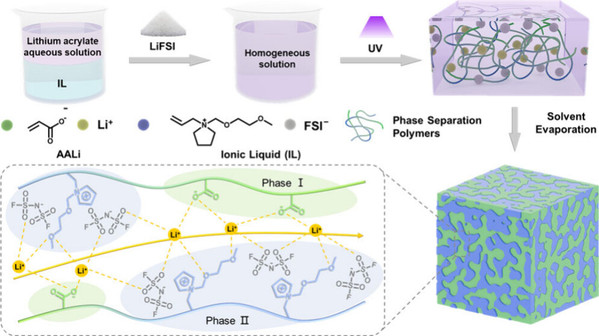
Abstract: Solid polymer electrolytes (SPEs) have attracted extensive attention owing to their flexibility and interfacial compatibility, offering a potential solution to interfacial issues in all-solid-state batteries (ASSBs). However, strong Li+–polymer coordination and inefficient ion-conducting pathways result in sluggish ion transport, which significantly hinders the advancement of ASSBs. Herein, we propose a dual-ion confined region strategy for preparing solid-state electrolytes with high ionic conductivity. An ionic phase-separated solid-state electrolyte (IPSE) with unique dual-ion confined-region conduction pathways and abundant ion transport sites is constructed by copolymerizing ionic monomers with incompatible properties. Furthermore, the ionic components promote lithium salt dissociation, offering more mobile Li+, whereas the competitive coordination of Li+ with anionic and cationic monomers weakens the interaction between Li+ and transport sites. Consequently, the IPSE electrolyte exhibits a high ionic conductivity of 1.2 mS cm–1 and a Li+ transference number of 0.78 at 25 °C. The Li||IPSE||Li symmetric batteries achieve stable cycling for over 2000 h at 0.2 mA cm–2 and 0.2 mAh cm–2. The Li||IPSE||LFP batteries maintain over 92% capacity retention after 200 cycles. This work provides an innovative strategy for constructing high-performance all-solid-state batteries with fast ion transport.
Article information:https://doi.org/10.1021/jacs.5c21322