
Self-Confinement Effect Enabled by Hollow Carbon Nanoreactor for High-Performance Li-Cl2 Battery
Xu Yan1(胥燕)*, Zhang Shenxiang1, Ye Jiejun1, Cao Xiwei1, Wang Zhipeng1, Sun Lidong2, Jiang Taoli2, Rummel Mark H.3*, Yan Feng1(严锋)*, Chen Wei2(陈维)*
1College of ChemistryChemical Engineering and Materials Science,Soochow University, Suzhou, Jiangsu 215006, China
2Department of Chemistry, School of Chemistry and Materials Science, Hefei National Research Center for Physical Sciences at the Microscale, University of Science and Technology of China, Hefei, Anhui 230026, China
3Electron Beam Emergent Additive Manufacturing (EBEAM) Centre, Centre for Nanotechnology (CNT), Centre for Energy and Environmental Technologies (CEET), VSB-Technical University of Ostrava, 17. Listopadu 15, Ostrava 708 33, Czech Republic
Adv. Mater. 2026, 38, e18732
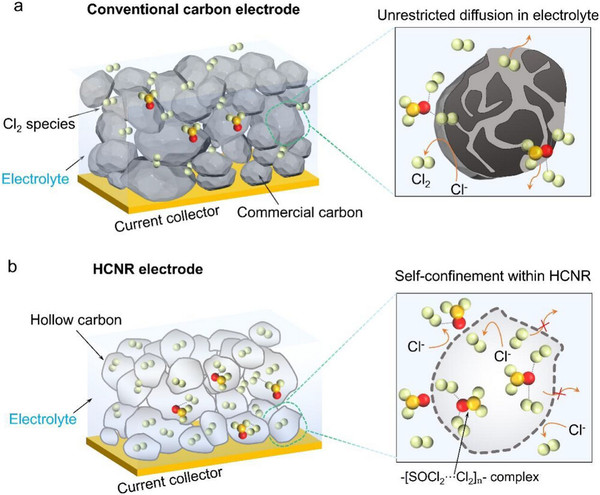
Abstract: Rechargeable Li-Cl2 batteries represent a promising high-energy-density technology. However, the open-pore structure of conventional cathode materials poses a fundamental challenge by permitting the uncontrolled diffusion of Cl2 into the electrolyte, resulting in severe local concentration dilution that plagues rate capability and specific capacity. Herein, a self-confinement strategy by hollow carbon nanoreactors (HCNRs) is proposed to regulate the local concentration of active Cl2 species with micropores (≈0.8 nm) on their walls. These micropores act as size-selective barriers, allowing to block the escape of larger active Cl2 species (kinetic diameter ≈0.86 nm), and mesopores (30-50 nm) function as nanoreactors that concentrate active Cl2 species. This design enables the as-assembled Li─Cl2 cell to achieve an ultrahigh current density of 100 mA cm-2 during thecharge/discharge process and a record-breaking specific capacity of 8000mAh g-1 (9 mAh cm-2 ), superior to the reported literature. This hollow nanoreactor design highlights the potential of Li-Cl2 batteries as high-power and energy-dense systems, paving the way for their practical application.
Article information: https://doi.org/10.1002/adma.202518732